A few sources today are reporting that the NHL is taking a hard line after Kovalchuk and may investigate a few contracts that they have previously approved.
Among those to be potentially investigated (if you believe any of the claims) would be those of Marian Hossa, Roberto Luongo, Chris Pronger and Marc Savard.
Never mind that the league won't be able to take away the Stanley Cup enabled by their previous soft stance. I prefer to see it in a different way.
If the league is dead set on killing all long-term front-end heavy contracts, let's get serious. What about making Gomez sign a new deal?
After all, he was one of the original new-era 7-year deal boys. His final season is paying him less than half of his first $10 million season.
And what about other teams who may want voided cap hits? Like Philly on Daniel Briere's $6.5 million? Maybe Detroit's rivals would want to investigate Franzen and Zetterberg.
Wouldn't seem fair otherwise, would it?
Showing posts with label Hossa. Show all posts
Showing posts with label Hossa. Show all posts
Thursday, September 02, 2010


Wednesday, August 12, 2009
Jacques Martin Again
Look Forward To Better Player Development
When I was putting together a piece on Jacques Martin, player development is what I had in mind. I have to admit to getting sidetracked by a tangential thought that grew into an article.
I say player development, because if winning against Toronto in the playoffs is what Jacques Martin is worst at, developing players into future stars is perhaps what he is best at. It's good thing too, because there's a fairly broad consensus on those who give report cards to the Canadiens organization that the mark for Gainey and co. should be "Needs improvement" or even "Unsatisfactory".
In fact, if one were to try and pinpoint the key element that has led to Gainey pressing reset on his five-year plan (i.e., the reason his original 5 years were eventually deemed a bust) it could well be player development. After all, 25 goalscorers completely losing confidence is right up there with sudden and inexplicable inability to win in the playoffs as the theme of the half decade. It's not nice to harp on about Carbonneau, but let's just say his name and "player development", though often finding their way into the same sentence were more often than not also accompanied by phrases like "has no aptitude for", "doesn't like" or "would rather go tie shopping".
Can't keep burning through prospects
The Canadiens have done an admirable job of piling up half decent prospects at most positions in the draft without really having to lose the league. But be realistic, they've been a bit lucky – they've avoided the busts that sometimes happen to even the best scouting departments. What this means for the future is probably that they are due a bust or two, and that they can't expect to keep pulling in top talent from later rounds.
When you're drowned in what seems like a wealth of new faces (like autumn 2007-08), ruining one or two careers or alienating a talent doesn't seem like such a big deal.
But it doesn't take long for the tide to turn does it?
A minute ago we had too many offensive minded centres to fit Grabovski into the plans. A few slumps and a few trades later and we're looking at Ben Maxwell to step in as the number two centre if there's an injury. I looked at centre, I could have looked at the wings, where there are even less enticing propositions.
From plenty to pittance in just a season – it's no wonder Gainey decided to say no more. In taking on Jacques Martin (who's more than a French Canadian, as we're discovering by the day), Bob has opted to put a stake in the development of the assets he has left. He has invested in a policy that might turn the career of Sergei Kostitsyn around, that might prevent Matt D'Agostini from descending from 8-goal wonder to on-ice nightmare again and who might even help more established stars push their limits.
It's a good gamble. And based on the past, it may just pay off.
Jacques Martin, the nurturer of offensive egos
The other day, I wrote about how Jacques was able to take the Pitiful 1996 Senators, stabilise their defence and then move to creating an offensive powerhouse. Not only that, he actually nurtured some of the leagues very best offensive talents so that they could fulfill their potential and score goals like they were expected to.
His record on developing goalscorers is very very impressive actually. For symmetry, I looked at two 4-year periods – that since the lockout to see the current goalscoring talent and those 4 years immediately before the lockout, which coincide with Martin's powerhouse Senators teams. What I found is that Jacques' players, those drafted and brought through the Ottawa system rose above the crops from other organizations.
Goalscorers since the lockout
Since the lockout, there have been 89 players to register 30 goal seasons.
5 players have done it 4 times
13 players have done it 3 times
20 players have done it 2 times
Among the 89, there were 4 players who started their careers on Jacques Martin team. But 2 of those (Alfredsson and Hossa) are among the elite 18 who've claimed 3 30-goal marks. One other (Spezza) has done it twice.
When you look at 40 goalscorers (the real elite), Alfredsson and Hossa stand out even more since they account 4 of 54 40-goal seasons across the whole league between them.
Goalscorers before the lockout
In the 4 years before the lockout, there were only 68 players to register 30 goal seasons.
6 players did it 4 times
10 players did it 3 times
18 players did it 2 times
Once again, Jacques' proteges were up there. Hossa, again was truly elite with 4 30-goal campaigns and one 45-goal season. Throw in three more (Yashin, Alfredsson and Demitra) with a couple of 30-goal seasons apiece and Havlat with one in his fourth season in the league and it looks good again for Jacques's fostering.
How did he do it?
I'm not going to suggest that he taught these guys how to score – that would be outlandish. It looks to me like he got a lot of help from the draft. After all, Yashin, Hossa, Spezza and Havlat are all first rounders. But as we should know by now in Montreal, draft talent does not always translate. We look at teams like Ottawa from that era and Detroit now and say "good drafting". But it goes beyond that, we have that. It's actually "good drafting, great development".
What one can say without question is that he didn't hinder their goalscoring instincts, even in a defensive system. And that is a strategy that Guy Carbonneau could never quite work out.
Jacaques Martin, the purveyor of defensive reliability
As he kept an eye on his talented forwards, Martin also kept another guiding hand for the upbringing of defensive prospects.
While I'll gladly concede that a goalscorer has all the skills he needs to score goals at the age of 20, a defenceman needs a tutor, he needs a really good one, too.
Just as we can rattle off 90-point and 40-goal seasons from the Ottawa graduates (that'd be nice to do again here one day – where are you Stephane Richer?), I can also recall a list of defencemen I would have listed as elite from Jacques time down the 417. Chara, Redden, Phillips, Volchenkov, Salo have all at times been decent to excellent defenders.
We're all to familiar with the recent exploits of Zdeno Chara, but does anyone remember what a terribly awkward 23-year old he was with the 2000-01 Islanders? Sure a change of team helped a lot, but from -27 one year to +30 the next has to say something about his own improvement too. I can honestly tell you from seeing the then pylon in orange and blue at the Bell Centre that Chara and Norris trophy were not in the same realm.
Equally, Wade Redden had an exemplary ten-year stint among the sub-Norris elite of the NHL defenders. A single season in the negative (and -1 at that) speaks to how he served a system for the benefit of the team and ultimately his bank account.
The other cast members, whoever they were (and notably Phillips) always made Ottawa a difficult team to play against and a difficult team to keep the puck away from. The coach must get a lot of credit here. You can see what impact he had, because for a while after he left Ottawa still assumed they could fill any hole on defence with the next guy in the depth chart, just as Martin always always did.
I know his years in Florida weren't anything to write home about. But I tell you what, When he went in Jay Bouwmeester was not as mature and dominating as he is now. is that despite Martin? Maybe. But I'd be surprised.
Player development in Montreal
All of this is good news for Montreal, I think. Bringing in a coach at this point who can foster personalities and flair and at the same time shape defencemen into contributors to the cause is something we've longed for.
I mentioned the forwards he could salvage like Sergei Kostitsyn and D'Agostini, but I can't see his influence being a bad thing on Plekanec, Andrei Kostitsyn, Latendresse, Cammalleri and some of the other relatively young guys either. What's more, he may just be able to make a Mike Fisher or two out of all those "defensive forwards" we have waiting in the wings.
What excites me more, though. And what I expect might have been going through Bob Gainey's mind is Jacques' potential to shape all those prospects coming through. It's about Josh Gorges' consistency, Ryan O'Byrne using his size, and Yannick Weber and PK Subban taking the right first steps. If even one of those 4 make significant strides, this signing will have improved our prospects over the defensive-forward trifecta.
Carey Price. What about Carey Price? Well, as for his personal development, I'm not sure. Jacques' record in turning out clutch goaltenders is nearly league worst. But, you never know, a better defence with some offensive conversion – maybe that alone will help Carey Price take the weight of the world off his shoulders enough that he can lift his left arm. We'll see.
A chance at making the playoffs without the customary ruining of 2 young careers. How's that for more reason to be positive about the season?
I say player development, because if winning against Toronto in the playoffs is what Jacques Martin is worst at, developing players into future stars is perhaps what he is best at. It's good thing too, because there's a fairly broad consensus on those who give report cards to the Canadiens organization that the mark for Gainey and co. should be "Needs improvement" or even "Unsatisfactory".
In fact, if one were to try and pinpoint the key element that has led to Gainey pressing reset on his five-year plan (i.e., the reason his original 5 years were eventually deemed a bust) it could well be player development. After all, 25 goalscorers completely losing confidence is right up there with sudden and inexplicable inability to win in the playoffs as the theme of the half decade. It's not nice to harp on about Carbonneau, but let's just say his name and "player development", though often finding their way into the same sentence were more often than not also accompanied by phrases like "has no aptitude for", "doesn't like" or "would rather go tie shopping".
Can't keep burning through prospects
The Canadiens have done an admirable job of piling up half decent prospects at most positions in the draft without really having to lose the league. But be realistic, they've been a bit lucky – they've avoided the busts that sometimes happen to even the best scouting departments. What this means for the future is probably that they are due a bust or two, and that they can't expect to keep pulling in top talent from later rounds.
When you're drowned in what seems like a wealth of new faces (like autumn 2007-08), ruining one or two careers or alienating a talent doesn't seem like such a big deal.
But it doesn't take long for the tide to turn does it?
A minute ago we had too many offensive minded centres to fit Grabovski into the plans. A few slumps and a few trades later and we're looking at Ben Maxwell to step in as the number two centre if there's an injury. I looked at centre, I could have looked at the wings, where there are even less enticing propositions.
From plenty to pittance in just a season – it's no wonder Gainey decided to say no more. In taking on Jacques Martin (who's more than a French Canadian, as we're discovering by the day), Bob has opted to put a stake in the development of the assets he has left. He has invested in a policy that might turn the career of Sergei Kostitsyn around, that might prevent Matt D'Agostini from descending from 8-goal wonder to on-ice nightmare again and who might even help more established stars push their limits.
It's a good gamble. And based on the past, it may just pay off.
Jacques Martin, the nurturer of offensive egos
The other day, I wrote about how Jacques was able to take the Pitiful 1996 Senators, stabilise their defence and then move to creating an offensive powerhouse. Not only that, he actually nurtured some of the leagues very best offensive talents so that they could fulfill their potential and score goals like they were expected to.
His record on developing goalscorers is very very impressive actually. For symmetry, I looked at two 4-year periods – that since the lockout to see the current goalscoring talent and those 4 years immediately before the lockout, which coincide with Martin's powerhouse Senators teams. What I found is that Jacques' players, those drafted and brought through the Ottawa system rose above the crops from other organizations.
Goalscorers since the lockout
Since the lockout, there have been 89 players to register 30 goal seasons.
5 players have done it 4 times
13 players have done it 3 times
20 players have done it 2 times
Among the 89, there were 4 players who started their careers on Jacques Martin team. But 2 of those (Alfredsson and Hossa) are among the elite 18 who've claimed 3 30-goal marks. One other (Spezza) has done it twice.
When you look at 40 goalscorers (the real elite), Alfredsson and Hossa stand out even more since they account 4 of 54 40-goal seasons across the whole league between them.
Goalscorers before the lockout
In the 4 years before the lockout, there were only 68 players to register 30 goal seasons.
6 players did it 4 times
10 players did it 3 times
18 players did it 2 times
Once again, Jacques' proteges were up there. Hossa, again was truly elite with 4 30-goal campaigns and one 45-goal season. Throw in three more (Yashin, Alfredsson and Demitra) with a couple of 30-goal seasons apiece and Havlat with one in his fourth season in the league and it looks good again for Jacques's fostering.
How did he do it?
I'm not going to suggest that he taught these guys how to score – that would be outlandish. It looks to me like he got a lot of help from the draft. After all, Yashin, Hossa, Spezza and Havlat are all first rounders. But as we should know by now in Montreal, draft talent does not always translate. We look at teams like Ottawa from that era and Detroit now and say "good drafting". But it goes beyond that, we have that. It's actually "good drafting, great development".
What one can say without question is that he didn't hinder their goalscoring instincts, even in a defensive system. And that is a strategy that Guy Carbonneau could never quite work out.
Jacaques Martin, the purveyor of defensive reliability
As he kept an eye on his talented forwards, Martin also kept another guiding hand for the upbringing of defensive prospects.
While I'll gladly concede that a goalscorer has all the skills he needs to score goals at the age of 20, a defenceman needs a tutor, he needs a really good one, too.
Just as we can rattle off 90-point and 40-goal seasons from the Ottawa graduates (that'd be nice to do again here one day – where are you Stephane Richer?), I can also recall a list of defencemen I would have listed as elite from Jacques time down the 417. Chara, Redden, Phillips, Volchenkov, Salo have all at times been decent to excellent defenders.
We're all to familiar with the recent exploits of Zdeno Chara, but does anyone remember what a terribly awkward 23-year old he was with the 2000-01 Islanders? Sure a change of team helped a lot, but from -27 one year to +30 the next has to say something about his own improvement too. I can honestly tell you from seeing the then pylon in orange and blue at the Bell Centre that Chara and Norris trophy were not in the same realm.
Equally, Wade Redden had an exemplary ten-year stint among the sub-Norris elite of the NHL defenders. A single season in the negative (and -1 at that) speaks to how he served a system for the benefit of the team and ultimately his bank account.
The other cast members, whoever they were (and notably Phillips) always made Ottawa a difficult team to play against and a difficult team to keep the puck away from. The coach must get a lot of credit here. You can see what impact he had, because for a while after he left Ottawa still assumed they could fill any hole on defence with the next guy in the depth chart, just as Martin always always did.
I know his years in Florida weren't anything to write home about. But I tell you what, When he went in Jay Bouwmeester was not as mature and dominating as he is now. is that despite Martin? Maybe. But I'd be surprised.
Player development in Montreal
All of this is good news for Montreal, I think. Bringing in a coach at this point who can foster personalities and flair and at the same time shape defencemen into contributors to the cause is something we've longed for.
I mentioned the forwards he could salvage like Sergei Kostitsyn and D'Agostini, but I can't see his influence being a bad thing on Plekanec, Andrei Kostitsyn, Latendresse, Cammalleri and some of the other relatively young guys either. What's more, he may just be able to make a Mike Fisher or two out of all those "defensive forwards" we have waiting in the wings.
What excites me more, though. And what I expect might have been going through Bob Gainey's mind is Jacques' potential to shape all those prospects coming through. It's about Josh Gorges' consistency, Ryan O'Byrne using his size, and Yannick Weber and PK Subban taking the right first steps. If even one of those 4 make significant strides, this signing will have improved our prospects over the defensive-forward trifecta.
Carey Price. What about Carey Price? Well, as for his personal development, I'm not sure. Jacques' record in turning out clutch goaltenders is nearly league worst. But, you never know, a better defence with some offensive conversion – maybe that alone will help Carey Price take the weight of the world off his shoulders enough that he can lift his left arm. We'll see.
A chance at making the playoffs without the customary ruining of 2 young careers. How's that for more reason to be positive about the season?
Wednesday, July 29, 2009
Playing The System
GMs That Are Ahead Of The Curve
Every time you hear that Saku Koivu is gone because he couldn't fit under the cap, think again.
Koivu, by virtue of celebrating his 35th birthday this November and not earlier was eligible to sign one of those brain-bustingly long salaries that could have been averaged out to a minimal cap hit.
You know the ones that Detroit and Scotty Bowman's Blackhawks are handing out?
Now, I fully believe that Gainey wanted the space on the team and not the space in the balance book when he waved goodbye to Saku, but what about some of his other signings? Where was the creativity when he signed up 30-year old Brian Gionta to a financially tying $5 million cap hit for the next 5 years?
It got me thinking about the better GMs in the NHL and what they have been doing to show up their slower peers.
The long contract
This summer has seen the advent of the extended contract beyond the age of 40 years old.
The idea behind the long contract has been a round a while now. The Islanders broke the ice with a 15-year deal to Rick DiPietro back in 2006. The Flyers gave out a few, most notably to Mike Richards.
But it was not until the Red Wings came along and signed Henrik Zetterberg that the manipulation of numbers really came into effect.
The DiPietro deal, you see was the same salary for every year of the contract. At the time, one could argue that it was an overpay for the player, an argument that only seems to take on more credence as time goes by. It was in effect, just a really bad long contract.
Ditto the Mike Richards deal. The Flyers handed out the deal to a 22-year old who'd had one decent year earlier in his breakout season. They ended up paying him a wad more than they could have been for the past year and by virtue of his age, the benefit of retirement is unlikely to help them. It opened the door for a trade later in the contract, but Holmgren just didn't have the same grasp on the possibilities as his sleeker peers. After all, a two-way forward like Mike Richards (if he's all we have to hear is from Flyers fans) will not be an untradeable asset by the age of 34. If he is, who would take on the $5.75 million cap hit anyway? Only teams covering the minimum...
The Zetterberg deal was different. It used term to reduce the average to a superstar player. Henrik will be paid a worthy salary of $7+ million for the next 9 seasons, then when he turns 37, he'll drop to half with 2 seasons at $1 million for the flourish. The drastic drop means the Wings pay the player over $7 million, but at a $6 million cap hit. Should he do the Forsberg and opt for cruising the Stockholm archipelago by his late 30s, the Wings have a minor cap coup and Zetterberg gets most of his money.
Always a team to push limits, the Wings went further with their next extension. Johan Franzen is tied to the team until the age of 39 as well, but at a bargain price just under $4 million a year on the cap. He will of course be paid well over $5 million a season (like Gionta) until his late 30s, but then opens the window to Scandinavian motor-boating with 4 final seasons where he'd only be collecting $7 million in all.

The Red Wings have set a revolution in place in this regard, but leave it to the master (and Holland's teacher) to show everyone that it can be done even better than that. The Marian Hossa contract is that masterpiece. In designing a contract that pays Hossa $3.5 million over the last 4 seasons, they were able to secure a $7.5 million dollar player at 2/3 the cap hit. Not only that, he stole Hossa from under the Wings' very noses.
While heralded in some quarters as madness, the reality is closer to genius. As this Ottawa Citizen article stated a few weeks ago:
Retirement is the key, and right now the possibilities to push this kind of salary are almost limitless. One blogger asks why stop at 12, 15 years; why not 30 years?
And he's right for asking, because although there are limits on contracts offered to players over the age of 35, there's no current limit as to the number of years a player of age 22 (like Carey Price for example) could be signed for. 30 seems ridiculous, but really why stop there?
Loophole will be closed
Upstanding NHL citizen, rarely jealous, spiteful or arrogant, Brian Burke is upset about the lack of fair play. And, he, along with other slowpokes, will probably see the loophole closed so that they can continue to get to grips with 1-year deals.
Funny how some loopholes seem more despicable than others to ole Brian.
Incidentally, as a Habs fan, I want this loophole closed and fast. It hardly seems fair that we be the only team still paying what the cap hit says to players whose performance is far from guaranteed. I think it's only fair that other teams, no matter how good their GMs should also be held to terrible contracts instead of being able to wriggle out, just because they are better at their jobs than their rivals.
"You're not thinking 4th dimensionally"
Gainey it seems is not in the same plane as his mosre successful rivals, at least not as a devious pursuer of vitory at all costs. After all, in addition to adding one of the worst value contracts in the whole league to his roster, he also gave out two of the most questionable deals of the summer to Cammalleri and Gionta.
I think he's failed us in this regard, he's not near the head of the class. And, just as Doc Brown scolded Marty for being such a simpleton (even after 2.5 movies worth of time travelling), I could see better GMs scolding Gainey for his summer:
Bob: "But I don't want Gionta for 22 years, I only want him for 5."
Doc Bowman: "Sign him for 22 years with every year after 40 at current league minimum. If he retires, you don't pay him."
Bob: "Still, that's almost 5 years of Gionta that I don't want."
Doc Bowman: "Bob, you're not thinking 4th dimensionally. Have you ever made a trade? Have you ever thought about how to become the best GM? Cap hits are important. By averaging salary over more time, you can reduce the cap hit for a future suitor. You make an untradeable asset tradeable, even within your ridiculous $5 million per year period..."
The man who tries so hard
Speaking of rivals, it's hard not to chuckle at poor Paul Holmgren who tries his very best to keep up with the Detroits and Chicagos of the world.
It started with Richards, whose contract we deem just expensive and unnecessarily unbalanced. It got even more comical with Briere and then Timonen. But this summer he really took the cake.
Taking his inspiration from Franzen and Hossa, Holmgren promptly signed newly acquired Chris Pronger to a long-term deal, well past the date where he'd be on the team. He even overpaid in a trade for the privilege.
At first glance what he did was OK. He signed a 34-year old defenceman to several years, the final ones (which he hopefully wouldn't play) at league minimum. What Paul didn't grasp was this – Chris Pronger had a contract already. His next contract will come into force next summer (and here's the tragedy) after he turn 35. If there was any doubt, it was cast aside when the league said that's how it would treat the deal.
Oops.
While trying to put together one of the best contracts in history, he has unwittingly added another chapter to the comedy of errors in the Flyers organization post-lockout. If Pronger retires instead of playing for $500 K, Holmgren's successor will be taking a $5 million cap hit for an empty locker – which would probably be up there for worst NHL contract ever. All's not lost though, he could force Pronger to play as he slows down and just have a really slow and ineffective defender for the very same cap hit.
Maybe Gainey missed saving a few million on Gionta, but at least he didn't Holmgren his team into a hole. Oh, it'll be fun to play those 2014-15 Flyers...
Koivu, by virtue of celebrating his 35th birthday this November and not earlier was eligible to sign one of those brain-bustingly long salaries that could have been averaged out to a minimal cap hit.
You know the ones that Detroit and Scotty Bowman's Blackhawks are handing out?
Now, I fully believe that Gainey wanted the space on the team and not the space in the balance book when he waved goodbye to Saku, but what about some of his other signings? Where was the creativity when he signed up 30-year old Brian Gionta to a financially tying $5 million cap hit for the next 5 years?
It got me thinking about the better GMs in the NHL and what they have been doing to show up their slower peers.
The long contract
This summer has seen the advent of the extended contract beyond the age of 40 years old.
The idea behind the long contract has been a round a while now. The Islanders broke the ice with a 15-year deal to Rick DiPietro back in 2006. The Flyers gave out a few, most notably to Mike Richards.
But it was not until the Red Wings came along and signed Henrik Zetterberg that the manipulation of numbers really came into effect.
The DiPietro deal, you see was the same salary for every year of the contract. At the time, one could argue that it was an overpay for the player, an argument that only seems to take on more credence as time goes by. It was in effect, just a really bad long contract.
Ditto the Mike Richards deal. The Flyers handed out the deal to a 22-year old who'd had one decent year earlier in his breakout season. They ended up paying him a wad more than they could have been for the past year and by virtue of his age, the benefit of retirement is unlikely to help them. It opened the door for a trade later in the contract, but Holmgren just didn't have the same grasp on the possibilities as his sleeker peers. After all, a two-way forward like Mike Richards (if he's all we have to hear is from Flyers fans) will not be an untradeable asset by the age of 34. If he is, who would take on the $5.75 million cap hit anyway? Only teams covering the minimum...
The Zetterberg deal was different. It used term to reduce the average to a superstar player. Henrik will be paid a worthy salary of $7+ million for the next 9 seasons, then when he turns 37, he'll drop to half with 2 seasons at $1 million for the flourish. The drastic drop means the Wings pay the player over $7 million, but at a $6 million cap hit. Should he do the Forsberg and opt for cruising the Stockholm archipelago by his late 30s, the Wings have a minor cap coup and Zetterberg gets most of his money.
Always a team to push limits, the Wings went further with their next extension. Johan Franzen is tied to the team until the age of 39 as well, but at a bargain price just under $4 million a year on the cap. He will of course be paid well over $5 million a season (like Gionta) until his late 30s, but then opens the window to Scandinavian motor-boating with 4 final seasons where he'd only be collecting $7 million in all.

The Red Wings have set a revolution in place in this regard, but leave it to the master (and Holland's teacher) to show everyone that it can be done even better than that. The Marian Hossa contract is that masterpiece. In designing a contract that pays Hossa $3.5 million over the last 4 seasons, they were able to secure a $7.5 million dollar player at 2/3 the cap hit. Not only that, he stole Hossa from under the Wings' very noses.
While heralded in some quarters as madness, the reality is closer to genius. As this Ottawa Citizen article stated a few weeks ago:
"The unspoken reality. GMs expect players to retire before those contracts are actually fulfilled -- but that seven- or 12-year term brings the average of the contract down to a very manageable level."
Retirement is the key, and right now the possibilities to push this kind of salary are almost limitless. One blogger asks why stop at 12, 15 years; why not 30 years?
And he's right for asking, because although there are limits on contracts offered to players over the age of 35, there's no current limit as to the number of years a player of age 22 (like Carey Price for example) could be signed for. 30 seems ridiculous, but really why stop there?
Loophole will be closed
Upstanding NHL citizen, rarely jealous, spiteful or arrogant, Brian Burke is upset about the lack of fair play. And, he, along with other slowpokes, will probably see the loophole closed so that they can continue to get to grips with 1-year deals.
Funny how some loopholes seem more despicable than others to ole Brian.
Incidentally, as a Habs fan, I want this loophole closed and fast. It hardly seems fair that we be the only team still paying what the cap hit says to players whose performance is far from guaranteed. I think it's only fair that other teams, no matter how good their GMs should also be held to terrible contracts instead of being able to wriggle out, just because they are better at their jobs than their rivals.
"You're not thinking 4th dimensionally"
Gainey it seems is not in the same plane as his mosre successful rivals, at least not as a devious pursuer of vitory at all costs. After all, in addition to adding one of the worst value contracts in the whole league to his roster, he also gave out two of the most questionable deals of the summer to Cammalleri and Gionta.
I think he's failed us in this regard, he's not near the head of the class. And, just as Doc Brown scolded Marty for being such a simpleton (even after 2.5 movies worth of time travelling), I could see better GMs scolding Gainey for his summer:
Bob: "But I don't want Gionta for 22 years, I only want him for 5."
Doc Bowman: "Sign him for 22 years with every year after 40 at current league minimum. If he retires, you don't pay him."
Bob: "Still, that's almost 5 years of Gionta that I don't want."
Doc Bowman: "Bob, you're not thinking 4th dimensionally. Have you ever made a trade? Have you ever thought about how to become the best GM? Cap hits are important. By averaging salary over more time, you can reduce the cap hit for a future suitor. You make an untradeable asset tradeable, even within your ridiculous $5 million per year period..."
The man who tries so hard
Speaking of rivals, it's hard not to chuckle at poor Paul Holmgren who tries his very best to keep up with the Detroits and Chicagos of the world.
It started with Richards, whose contract we deem just expensive and unnecessarily unbalanced. It got even more comical with Briere and then Timonen. But this summer he really took the cake.
Taking his inspiration from Franzen and Hossa, Holmgren promptly signed newly acquired Chris Pronger to a long-term deal, well past the date where he'd be on the team. He even overpaid in a trade for the privilege.
At first glance what he did was OK. He signed a 34-year old defenceman to several years, the final ones (which he hopefully wouldn't play) at league minimum. What Paul didn't grasp was this – Chris Pronger had a contract already. His next contract will come into force next summer (and here's the tragedy) after he turn 35. If there was any doubt, it was cast aside when the league said that's how it would treat the deal.
Oops.
While trying to put together one of the best contracts in history, he has unwittingly added another chapter to the comedy of errors in the Flyers organization post-lockout. If Pronger retires instead of playing for $500 K, Holmgren's successor will be taking a $5 million cap hit for an empty locker – which would probably be up there for worst NHL contract ever. All's not lost though, he could force Pronger to play as he slows down and just have a really slow and ineffective defender for the very same cap hit.
Maybe Gainey missed saving a few million on Gionta, but at least he didn't Holmgren his team into a hole. Oh, it'll be fun to play those 2014-15 Flyers...
Tuesday, June 30, 2009
Tomorrow Never Knows
Into The Free Agency Void
Turn off your mind, relax and float down stream.
It is not dying, it is not dying.
Lay down all thought, surrender to the void
It is shining, it is shining.
Free agency tomorrow. Surrender to the void Habs fans.
Free agent preview
The previews for tomorrow's festivities must surely number in the thousands by now. I don't want to re-invent the wheel, so I'll make it simple. For me the most concise and useful previews were the following:
USA Today – Most popular: 25 free agents who'll draw plenty of interest
THN: The NHL's all-overlooked free agent team
Of the two, I'd most recommend the second because it eschews the more obvious diatribe about Bouwmeester, the Sedins and Gaborik – who in our hearts of hearts we all know we won't sign tomorrow anyway. Besides, the bargains in this free agency mess don't come from the top ten – where thanks to Philadelphia and New York, one always overpays.
Forwards
Unfortunately, we may be in a bit of a pickle. Even with Koivu, Kovalev and Tanguay we needed a top forward to add a second wave. If we lose all those three, we need four.
While I'm not a fan of overpayment on every player, it seems to get a star forward (with the trade route barred to us), one must. Of the top players, I'd take Koivu and Kovalev back and stick with the trade option until we find a way to pry away that premier goalscorer we need. If Tanguay finds his real value is a pay cut, I'd welcome him back too.
If it's to be done tomorrow, I'd want Gainey to be in on conversations about Hossa and Havlat with a possible look at Mikael Samuelsson. The Sedins have a lot of allure, but a package deal? How old are you guys?
In addition, to replace Kostopoulos with a more skillful option, I'd take THN's advice and look into Joel Ward:
Defence
Unlike Gainey, I'd let Komisarek go without any fight. I can't for the life of me decide why he thinks differently, but then we share different opinions of what makes a thoroughbred, after all. While everyone's worrying about Jay Bouwmeester and Big Mike, I'd be swoping for some #3/4 guys to really get a solid squad at the back.
Someone I've been hot on for ages now is Johnny Oduya of the Devils. On him, THN says it nicely:
In keeping with the THN advice, I also thought someone just like Christian Backman would be a very nice addition and Brisebois-signing barrier. As they say:
Goalies
The fact is we need one for Hamilton. It could be Marc Denis, but I'd want a promise of no games in Mtl. Here I'd really veer towards the young and someone who might not mind sitting behind two or three better prospects. This isn't a July 1 priority and may come via trade as well...
A mentor for Carey Price? How about a blanket? The guy is coddled. He doesn't need his own mentor to take up salary and dispatch Halak. He'll have his own coach and he'll have to make do.
So, sit back, relax and enjoy the fun. And remember tomorrow never never knows. The team you think is a bottom-feeder tomorrow may be a contender come April.
... play the game, existence to the end.
Of the beginning, of the beginning...
It is not dying, it is not dying.
Lay down all thought, surrender to the void
It is shining, it is shining.
Free agency tomorrow. Surrender to the void Habs fans.
Free agent preview
The previews for tomorrow's festivities must surely number in the thousands by now. I don't want to re-invent the wheel, so I'll make it simple. For me the most concise and useful previews were the following:
USA Today – Most popular: 25 free agents who'll draw plenty of interest
THN: The NHL's all-overlooked free agent team
Of the two, I'd most recommend the second because it eschews the more obvious diatribe about Bouwmeester, the Sedins and Gaborik – who in our hearts of hearts we all know we won't sign tomorrow anyway. Besides, the bargains in this free agency mess don't come from the top ten – where thanks to Philadelphia and New York, one always overpays.
Forwards
Unfortunately, we may be in a bit of a pickle. Even with Koivu, Kovalev and Tanguay we needed a top forward to add a second wave. If we lose all those three, we need four.
While I'm not a fan of overpayment on every player, it seems to get a star forward (with the trade route barred to us), one must. Of the top players, I'd take Koivu and Kovalev back and stick with the trade option until we find a way to pry away that premier goalscorer we need. If Tanguay finds his real value is a pay cut, I'd welcome him back too.
If it's to be done tomorrow, I'd want Gainey to be in on conversations about Hossa and Havlat with a possible look at Mikael Samuelsson. The Sedins have a lot of allure, but a package deal? How old are you guys?
In addition, to replace Kostopoulos with a more skillful option, I'd take THN's advice and look into Joel Ward:
"At 28, Ward was too old to be rookie-eligible last season (he played 11 NHL games in 2007-08). But he scored 17 goals while cast in a defensive role for the Predators, including a couple shorthanded markers. This guy can fly, adding wings to any team's forecheck."
Defence
Unlike Gainey, I'd let Komisarek go without any fight. I can't for the life of me decide why he thinks differently, but then we share different opinions of what makes a thoroughbred, after all. While everyone's worrying about Jay Bouwmeester and Big Mike, I'd be swoping for some #3/4 guys to really get a solid squad at the back.
Someone I've been hot on for ages now is Johnny Oduya of the Devils. On him, THN says it nicely:
"Do you want Johnny Oduya? Yes, you do, if you're a fan of two-way defensemen at a bargain-basement price."
In keeping with the THN advice, I also thought someone just like Christian Backman would be a very nice addition and Brisebois-signing barrier. As they say:
"Quietly efficient and ever improving, Backman is the kind of support player that every blueline needs."
Goalies
The fact is we need one for Hamilton. It could be Marc Denis, but I'd want a promise of no games in Mtl. Here I'd really veer towards the young and someone who might not mind sitting behind two or three better prospects. This isn't a July 1 priority and may come via trade as well...
A mentor for Carey Price? How about a blanket? The guy is coddled. He doesn't need his own mentor to take up salary and dispatch Halak. He'll have his own coach and he'll have to make do.
So, sit back, relax and enjoy the fun. And remember tomorrow never never knows. The team you think is a bottom-feeder tomorrow may be a contender come April.
... play the game, existence to the end.
Of the beginning, of the beginning...
Wednesday, July 09, 2008
The Reshuffle: A Look At Recent NHL Moves
July is the time for player movement in the NHL. Just ask Tampa.
Bad teams make loads of manoeuvres to try and dig themselves out of the whole, Philly and the Rangers can't help themselves and other teams get involved when players that interest them come up. From a Canadiens point of view, things could have gone better, but let's not forget, things could have gone a whole lot worse as well.
Last week, I declared some winners and losers for moves made up to July 1. I had Phoenix , New Jersey, Chicago and Edmonton at the top of the heap. At the bottom, struggling for air, I put Atlanta, Ottawa, Nashville and LA. Well, another week and not too much has changed, the winners have not done so much damage as to fall from grace, nor have the losers done enough to dig themselves out from the bottom of the heap. It would be negligent not to tip the hat to Detroit, who once again took the best player available to bolster their champion roster and to note new loser addition, Philadelphia, whose GM is beginning to show he has absolutely no grasp on what it takes to build a team beyond moving players in and out.
Funny, though isn't it? There are only two teams in the NHL who one can truly look to and think dynasty – the Red Wings and the Devils. Both, despite not making 53 signings like Tampa, come out winners this off season. Both present the perfect example for any aspiring team to follow. New Jersey swooped in and added Holik and Rolston. Second line scoring and big centre checked off their list. Detroit, with few glaring holes, did correspondingly, very little – only moving to pick up the only scoring star with years ahead of him from the entire group. No bad signings, no changes for the sake of it.
Big stories
While looking at players in and out is interesting and fun, most teams make like for like changes and hope for the best. As such, the stories around the moves are few. This year was unique in some ways though, as free agency has offered up some very interesting stories and trends for comment:
1) Jagr signing in Russia
By far the most significant signing of the off-season was Jagr's move to Russia. Funny then that this move has been treated as a footnote in most accounts.
The reason I think it is so notable is because of the precedent it sets. Jagr is the first bona fide NHL star to sign in a different league. Forsberg and Naslund often threatened, but could never ignore the call of the greenback. Aleksey Morozov blazed a trail, but one would hardly class him among the stars of the league. Jaromir, on the other hand, was reasonably close to becoming the second leading scorer of all time, a perennial all-star and Art Ross threat and the core of his NHL team.
While Siberian winters don't meet with everyone's tastes, multi-million dollar contracts do. I think from here on, the threat of players moving to the rival Russian league is real. It is a worry for young prospects to full-fledged stars. What's more, the longer the NHL allows the festering wound of the partial IIHF agreement (without Russia) to linger, the greater this problem will likely become. It may not be within the decade, but at some point, it is reasonable to assume that the NHL and the Russian league will duke it out for players like the Premiership, la Liga and Serie A do in football.
2) Retirement decisions
Admittedly, the retirement precedent was set prior to this season. However, this free agent season is the first in memory where 3 of the top 10 catches would be considering retirement from the league.
By prolonging their indecision, Sundin, Selanne and Sakic have created a force in the market. The force is patient money. There are teams sitting on money at the moment that they are saving to spring on Sundin in particular, while making bit parters wait for their turn.
I am not 100% behind the opinion that Sundin has disrupted the whole league (like this guy), but you have to admit, the poor guys waiting to buy/rent their houses for the season (4th liners, minor leaguers and down) are being put through a stressful period. That being said, I don't think it is Sundin's fault team's are shaping their whole strategy around him. Besides, how sorry can I feel for a guy who is slightly disrupted in finding a house (while I live in a small apartment) ahead of playing hockey for a living for another year.
No, for me, the more interesting thing to come out of this has been the reaction of the GMs. Sather, rumoured to be in the running for Sundin, has gone ahead with what could be called makeshift moves, even in the wake of losing Jagr. Gillis in Vancouver has sat pat, dangerous considering who he's lost. Fletcher is trying desperately to fill cap space with anyone and anything to be sure there's no room for Sundin. And, Gainey has signed his RFAs and made minor deals. Fans may be frustrated with the patience their GM is showing (or not), but ultimately only patience will leave a team with enough space to sign Sundin. Nothing less.
In the future, players teetering on the edge of retirement could shape the free agent game significantly. Imagine for example that Sundin does sign, his team does well and even wins. In future years, the lesson to good GMs will be that waiting for the best player available is the best move there is. It could make free agency less of a one-day (laughably televised) extravaganza and more of a prolonged and patient game. From the money thrown in desperation at players like Malone and Finger, I wouldn't see it as a bad thing.
3) Questions about the salary floor
When I look at the Columbus Blue Jackets, I see a team with little or no plan. How could anyone rational explain the Commodore signing to me. How could signing a 14-goalscorer at first line money be spun positively. But you see, Columbus has their backs up against it. They have never drafted a great player (arguments could be made for Nash...) and rarely ever draft anyone good.
How can this team possibly be expected to pay $40+M to a team of players. It is an unreasonable request. Stack that next to the fact that the team has no history, no plan, no immediate hope for greatness and you can see why the Hossas of the world elude them. As such, the Blue Jackets are forced to throw money at subpar performers just to reach that lower limit.
In and of itself, this is not a problem, but consider that that Rick Nash contract has influenced money for 21 year-olds years on, and you can see the ripples a signing in an NHL backwater can make. Any reasonably intelligent agent will be toting Mike Commodore's contract status and statistics in his negotiations next spring. 20-goal men across the continent will want to see Umberger dough (hey Ryder got it!).
Besides forcing real talents to play in outposts, what can the NHL do to avoid this market force from creating imbalance of pay/talent ratios?
Remove the floor? Impossible, watch Nashville owners pile up the cash if they do...
I don't have the answer, I can only see the problem at the moment. I feel there must be a solution at some point though, otherwise this may create another catalyst for players to Europe.
And the Canadiens?
All that is very interesting. From an academic point of view. But, let's be honest, how does it affect the Habs?
I've mentioned the Sundin affair, and I think the Habs are doing the right thing in keeping some money for him should he become available, although he wouldn't be my first choice (Selanne, ahem). Basically, what's the rush to spend: there are no great players left, and the team is mostly in place. Gainey can finish the roster off in August or September if he really needs to.
The Jagr debacle has not affected the Canadiens yet, but it will be interesting to see where the deeply patriotic Kovalev ends after his contract expires. In 5 years, this could be an issue for Markov, too. I have voiced my opinion on creating a special team of scouts/negotiators to deal with Russia before, and it still stands. Even without the threat of player flight, the pickings from Russian draft years alone warrant this approach.
Like Jagr, small market disproportionate spending has not thrown a wrench into the works yet. But when Plekanec, Kostitsyn and Higgins are all up for their third contract, will they take less than Columbus' plumbers?
The Canadiens moves themselves have been middle of the road. The Tanguay trade was excellent, but ultimately they relieved Calgary of a headache, who has yet to prove he won't be one here (I actually think he'll be great, but am keeping my feet on the ground just now). The Grabovski trade was poor indeed – losing a potential scorer for a non-entity. The signings of RFAs have been outstanding, but the UFA activity has been lacklustre to depressing (where the balance shows Streit, Danis and Ryder in the red for Laraque and Denis in the black). The player math shows Tanguay has to replace Ryder at even strength and Streit on the PP, while we hope that the youngsters will step up to take even more responsibility.
Frankly, at this point, barring a Sundin/Selanne/Sakic signing, I'd almost hope Gainey would call it a day. I am with him and his staff about the quality of our young players. Andrei Kostitsyn in particular will be a real force to be reckoned with if he plays a full season at his post-December clip. At the back, the deletion of Brisebois almost makes up for the loss of Streit, simply by inducing the addition by subtraction trick (fingers crossed, that particular element of today's status quo is with us come October).
Looking down the list, is there anyone any of you would make a legitimate case for? Even after Samsonov?
Bad teams make loads of manoeuvres to try and dig themselves out of the whole, Philly and the Rangers can't help themselves and other teams get involved when players that interest them come up. From a Canadiens point of view, things could have gone better, but let's not forget, things could have gone a whole lot worse as well.
Last week, I declared some winners and losers for moves made up to July 1. I had Phoenix , New Jersey, Chicago and Edmonton at the top of the heap. At the bottom, struggling for air, I put Atlanta, Ottawa, Nashville and LA. Well, another week and not too much has changed, the winners have not done so much damage as to fall from grace, nor have the losers done enough to dig themselves out from the bottom of the heap. It would be negligent not to tip the hat to Detroit, who once again took the best player available to bolster their champion roster and to note new loser addition, Philadelphia, whose GM is beginning to show he has absolutely no grasp on what it takes to build a team beyond moving players in and out.
Funny, though isn't it? There are only two teams in the NHL who one can truly look to and think dynasty – the Red Wings and the Devils. Both, despite not making 53 signings like Tampa, come out winners this off season. Both present the perfect example for any aspiring team to follow. New Jersey swooped in and added Holik and Rolston. Second line scoring and big centre checked off their list. Detroit, with few glaring holes, did correspondingly, very little – only moving to pick up the only scoring star with years ahead of him from the entire group. No bad signings, no changes for the sake of it.
Big stories
While looking at players in and out is interesting and fun, most teams make like for like changes and hope for the best. As such, the stories around the moves are few. This year was unique in some ways though, as free agency has offered up some very interesting stories and trends for comment:
1) Jagr signing in Russia
By far the most significant signing of the off-season was Jagr's move to Russia. Funny then that this move has been treated as a footnote in most accounts.
The reason I think it is so notable is because of the precedent it sets. Jagr is the first bona fide NHL star to sign in a different league. Forsberg and Naslund often threatened, but could never ignore the call of the greenback. Aleksey Morozov blazed a trail, but one would hardly class him among the stars of the league. Jaromir, on the other hand, was reasonably close to becoming the second leading scorer of all time, a perennial all-star and Art Ross threat and the core of his NHL team.
While Siberian winters don't meet with everyone's tastes, multi-million dollar contracts do. I think from here on, the threat of players moving to the rival Russian league is real. It is a worry for young prospects to full-fledged stars. What's more, the longer the NHL allows the festering wound of the partial IIHF agreement (without Russia) to linger, the greater this problem will likely become. It may not be within the decade, but at some point, it is reasonable to assume that the NHL and the Russian league will duke it out for players like the Premiership, la Liga and Serie A do in football.
2) Retirement decisions
Admittedly, the retirement precedent was set prior to this season. However, this free agent season is the first in memory where 3 of the top 10 catches would be considering retirement from the league.
By prolonging their indecision, Sundin, Selanne and Sakic have created a force in the market. The force is patient money. There are teams sitting on money at the moment that they are saving to spring on Sundin in particular, while making bit parters wait for their turn.
I am not 100% behind the opinion that Sundin has disrupted the whole league (like this guy), but you have to admit, the poor guys waiting to buy/rent their houses for the season (4th liners, minor leaguers and down) are being put through a stressful period. That being said, I don't think it is Sundin's fault team's are shaping their whole strategy around him. Besides, how sorry can I feel for a guy who is slightly disrupted in finding a house (while I live in a small apartment) ahead of playing hockey for a living for another year.
No, for me, the more interesting thing to come out of this has been the reaction of the GMs. Sather, rumoured to be in the running for Sundin, has gone ahead with what could be called makeshift moves, even in the wake of losing Jagr. Gillis in Vancouver has sat pat, dangerous considering who he's lost. Fletcher is trying desperately to fill cap space with anyone and anything to be sure there's no room for Sundin. And, Gainey has signed his RFAs and made minor deals. Fans may be frustrated with the patience their GM is showing (or not), but ultimately only patience will leave a team with enough space to sign Sundin. Nothing less.
In the future, players teetering on the edge of retirement could shape the free agent game significantly. Imagine for example that Sundin does sign, his team does well and even wins. In future years, the lesson to good GMs will be that waiting for the best player available is the best move there is. It could make free agency less of a one-day (laughably televised) extravaganza and more of a prolonged and patient game. From the money thrown in desperation at players like Malone and Finger, I wouldn't see it as a bad thing.
3) Questions about the salary floor
When I look at the Columbus Blue Jackets, I see a team with little or no plan. How could anyone rational explain the Commodore signing to me. How could signing a 14-goalscorer at first line money be spun positively. But you see, Columbus has their backs up against it. They have never drafted a great player (arguments could be made for Nash...) and rarely ever draft anyone good.
How can this team possibly be expected to pay $40+M to a team of players. It is an unreasonable request. Stack that next to the fact that the team has no history, no plan, no immediate hope for greatness and you can see why the Hossas of the world elude them. As such, the Blue Jackets are forced to throw money at subpar performers just to reach that lower limit.
In and of itself, this is not a problem, but consider that that Rick Nash contract has influenced money for 21 year-olds years on, and you can see the ripples a signing in an NHL backwater can make. Any reasonably intelligent agent will be toting Mike Commodore's contract status and statistics in his negotiations next spring. 20-goal men across the continent will want to see Umberger dough (hey Ryder got it!).
Besides forcing real talents to play in outposts, what can the NHL do to avoid this market force from creating imbalance of pay/talent ratios?
Remove the floor? Impossible, watch Nashville owners pile up the cash if they do...
I don't have the answer, I can only see the problem at the moment. I feel there must be a solution at some point though, otherwise this may create another catalyst for players to Europe.
And the Canadiens?
All that is very interesting. From an academic point of view. But, let's be honest, how does it affect the Habs?
I've mentioned the Sundin affair, and I think the Habs are doing the right thing in keeping some money for him should he become available, although he wouldn't be my first choice (Selanne, ahem). Basically, what's the rush to spend: there are no great players left, and the team is mostly in place. Gainey can finish the roster off in August or September if he really needs to.
The Jagr debacle has not affected the Canadiens yet, but it will be interesting to see where the deeply patriotic Kovalev ends after his contract expires. In 5 years, this could be an issue for Markov, too. I have voiced my opinion on creating a special team of scouts/negotiators to deal with Russia before, and it still stands. Even without the threat of player flight, the pickings from Russian draft years alone warrant this approach.
Like Jagr, small market disproportionate spending has not thrown a wrench into the works yet. But when Plekanec, Kostitsyn and Higgins are all up for their third contract, will they take less than Columbus' plumbers?
The Canadiens moves themselves have been middle of the road. The Tanguay trade was excellent, but ultimately they relieved Calgary of a headache, who has yet to prove he won't be one here (I actually think he'll be great, but am keeping my feet on the ground just now). The Grabovski trade was poor indeed – losing a potential scorer for a non-entity. The signings of RFAs have been outstanding, but the UFA activity has been lacklustre to depressing (where the balance shows Streit, Danis and Ryder in the red for Laraque and Denis in the black). The player math shows Tanguay has to replace Ryder at even strength and Streit on the PP, while we hope that the youngsters will step up to take even more responsibility.
Frankly, at this point, barring a Sundin/Selanne/Sakic signing, I'd almost hope Gainey would call it a day. I am with him and his staff about the quality of our young players. Andrei Kostitsyn in particular will be a real force to be reckoned with if he plays a full season at his post-December clip. At the back, the deletion of Brisebois almost makes up for the loss of Streit, simply by inducing the addition by subtraction trick (fingers crossed, that particular element of today's status quo is with us come October).
Looking down the list, is there anyone any of you would make a legitimate case for? Even after Samsonov?
Sunday, May 11, 2008
From Souray to Huet: A Year of Gainey
Since people have been calling me audacious to challenge the reign of Bob Gainey, I have been meaning to explain myself. I was actually trying to come up with a title and a direction for a post just yesterday, when I read this piece by Eric Engels on hockeybuzz.com
The piece gave me direction (almost directly opposite) and a title. So here we go.
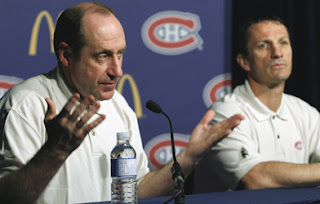
Let me start at the beginning here, by summarising why criticism of Bob Gainey (GM) is even pertinent at this time:
Eric Engels begins his own article by wondering how anyone could question Gainey. I think he is calling me (and others who question Gainey) a moron:
I suppose I merited that tag for being unclear. Of course, I don't question Bob Gainey's commitment, integrity or hockey knowledge. But, unfortunately for Bob, he is not the only good GM around. He is not even the only GM trying to set up a winning team. He is not the only GM to oversee a team with improving fortunes, either. I suppose the criticism (which I called disappointment) is that Bob, while doing an excellent job, is being outperformed. Or, at least has been outperformed over the last months. And, since there is only one trophy, being outperformed often means going home trophyless at the end of 8 long months of hockey.
Bob Gainey as GM has shown great talent for man management and hirings in the front office, a knack for the amateur draft and for signing players to good value contracts without hand-cuffing the franchise. His area of weakness, in my opinion, has been the addition of existing NHL talent – more specifically still: trades.
If you compare Bob to his peers, he appears to be more patient, more cerebral, and more cautious. All these characteristics serve him well for many of his duties, but as I questioned before, will Gainey be able move away from his patient, cautious approach and seize an opportunity when it comes?
Darren (from the comments of the last entry) noted that the Penguins GM, also in the midst of building a team gave up a lot for Marian Hossa, as he judged there was a chance to push for the Cup. At present, it seems like Shero's move is paying dividends, but we have yet to receive the final verdict. In any case, I wouldn't be writing this article about my GM if I were a Pittsburgh fan today. Shero wasn't the only GM to move. Brett Hull made a sly trade for Brad Richards, and his Stars, while reeling, are still alive too. Detroit didn't move too much at the deadline (Brad Stuart for free though), but amazed again last summer by adding the top free agent defenceman to their already talent-laden camp. While I don't like what Paul Holmgren did with the Flyers, no one can deny the jump they made in the standings. His notable addition of a veteran goalie has helped stem the tide of Nittymaki free-fall.
I could go beyond these four as well, but I won't. All this was to show that Bob Gainey, a talented guy, has talented peers too. And, from the looks of it, they are beating him handily at trades and attracting free agents, while he builds the patient way. I think if he wants to bring his team to the top table, he has to get a bit braver. If the biggest decision you make all season is whether to trade away impending free agents or not, perhaps he is getting left behind.
I say this like I say Plekanec needs to work on face-offs – a mere statement of opinion that one aspect of Bob's game could use a shine.
Evidence: a few recent decisions
Not trading Souray
Trading Souray would have been an obvious admission of defeat on the part of Bob Gainey. In his 5-year rebuilding plan, missing the playoffs in 2007 was a step backwards considering the team being employed in games and the free agent signings of the summer.
The incongruency with other moves (Rivet trade), however, suggests that Gainey may have attempted to trade Souray, but felt the value he would get in return was too low. Too low, even compared to 20 odd games worth of Sheldon, that is. It is also conceivable that Gainey legitimately wanted to sign Souray; and, as such, kept his man on board in order that they might work out a deal later. Either of these two give Gainey a legitimate excuse for the non-trade.
However, in the case of the Souray non-trade, I think we would be correct in speculating, however, that the playoffs (both for Gainey's record and Gillett's pocketbook) were a factor. If so, any reasonable critic could state that Gainey tampered with future success for a low-hanging fruit. A critic would not be wrong in pointing out that the move this year was inconsistent with the move last year – even at the risk of being called a moron by the eminent Mr. Engels.
My personal stance on Souray is ambivalence. I think calling him our best player last season is a stretch, considering how poor he was in his day-to-day position. It would have been nice to get something for him, but, I think the other GMs were wise to his deficiencies – so value would be lower. His points and goals during the stretch run provided hope and most of all entertainment.
At the end of the day, it's safe to say, I would have been upset with a draft pick for Souray just as I was for Huet.
Trading Huet
At the risk of angering the "get over it" gang, I'll voice my displeasure over this trade once again.
I should probably start by saying I would be pretty unhapppy at getting a second round pick for 80% of the current team. In principle, I think trading an NHL-calibre body for a 10% chance of getting an NHL body at some point in the future is lunacy. Apart from high first round picks, there are no guarantees in the draft. A second-round pick can turn into something special, but on average it won't.
I am also very much against making negative trades with players that aren't causing a problem of some kind on the team (let's say Dagenais as an example for that). There is absolutely nothing wrong, in my opinion, with losing a player for nothing if it means you get to keep that player for 20+ games. I have many times criticised Rejean Houle for this kind of negative management, and so to see Gainey resort to it was disappointing to say the least.
I also have to state, though, that I have absolutely nothing against a GM using his knowledge of the situation and intuition to determine that the time for his team is just not now. The Huet trade, if nothing else, announced to me that the GM of the team did not think he had the horses to run with Detroit, Dallas, Anaheim or San Jose. The evidence from the season would certainly prove him right.
All that said, I have yet to be convinced by anyone that trading Huet was necessary to allow Carey Price more starts – he could have been played more regardless of who was backing him up. Or to give Halak a real chance – but I think evidence for that theory has been blown out of the water. Or that Huet was a problem in the dressing room.
So what gives?
It all comes back to either money or the negative trade. Neither option offers anything positive for me.
You all know my opinion on Huet. But, on the trade itself, I was also disappointed. Brave would have been holding Huet when finding all you could get would be a second round pick. I thought the decision was neither brave nor creative. Creative would have been trading Halak in the hope that Washington would cough up more. What irks me is how unproductive and unnecessary the trade was. All told, it brought Gainey back down off his pedestal for me.
The Hossa non-trade
It's much more difficult to debate a non-trade than a trade since nothing is really known about it. What we do know about this particular non-trade was that Gainey was interested and he balked before the deadline at some point.
This non-trade is more interesting than the billions of other possibilities that could be dreamed up becuase it involved Marian Hossa – a scoring winger for Koivu. You see Hossa is a legitimate NHL star. He is a 40-goal threat, a puck carrier, a shooter and a nightmare for opposing teams to plan for. Most players could only dream of being as good as Hossa has been already.
The rumour is that player 1 in the trade for us was Christopher Higgins (at least for Waddell). For players like Hossa, a GM pays heavily (nothing is free), but in getting the best player in the trade often wins the trade by a landslide. In my opinion, it wouldn't matter who players 2, 3 and 4 were – especially if they were not in the NHL. So you have Higgins (and friends) for Hossa (20+ games). Under the circumstances, I think Gainey did the right thing here (especially having already traded goaltender insurance). A playoff rental would have gone against the grain of the team this year.
The order of proceedings
Finally, with regard to the trade deadline this season, you have the order of events prior to the trade deadline. Huet is traded then some time later Gainey pulls out of the Hossa trade.
This is noteworthy because it is in this order and not the opposite: Gainey pulls out of the Hossa trade then trades Huet.
In the latter, Gainey would have been trying to push his team over the top, been stifled, pulled out and then got what he could for a player who he deemed replaceable and unsignable.
In the former (and real) scenario, Gainey appeared to waver. It's only speculative of course, but by trading his number one goalie from a mere 2 weeks earlier (all-star and NHL three-star from January), Gainey paints the picture that he doesn't believe in the Habs playoff chances. Fair enough, he was probably right, but why then pursue a playoff addition like Hossa?
The move doesn't defy logic or anything, but it does defy (at least a little again) the idea that Gainey is infallible and without peer in the NHL.
The verdict
I hope Bob Gainey supporters understand that I still very much think he is a great GM. Possibly the best in the league, and certainly the best man for the Montreal Canadiens job. I merely question whether he will be able to deliver Detroit-style decade-long dominance if he doesn't adjust his game.
In my opinion, if he is to turn another rebuilding team into a dynastic rule, he must get a bit braver and more creative. I specifically point to trades as his area to focus his work on, as most other aspects of his GM play are top of the charts.
Nowadays, the price you should expect to pay to win the Cup is steep. This is simply because teams are playing for the single Cup – they will give up 5 years from now for this year. I think, as stated earlier, that he does need to be brave – probably this summer or next season – to add bodies the way his peers with playoff hockey to play and trophies in their cupboard do.
To win, even once, Gainey will have to play their game a little. If Gainey doesn't, and doesn't as a result ever move to the 6th year in his 5-year plan, we may just be lamenting the upshot team of the year (see Flyers this year) for many years to come.
The piece gave me direction (almost directly opposite) and a title. So here we go.

Let me start at the beginning here, by summarising why criticism of Bob Gainey (GM) is even pertinent at this time:
- The NHL season is not over, but the Canadiens are out
- The Canadiens lost to an opponent whom they beat 4 times in the regular season, in the majority of games the season before, were the worst team in the NHL the year before, in 5 games
- Bob Gainey both made moves and refrained from making moves over the season
Eric Engels begins his own article by wondering how anyone could question Gainey. I think he is calling me (and others who question Gainey) a moron:
What do you think of Bob Gainey now? It’s amazing how many people can doubt someone with as much integrity, and hockey-knowledge as Bob Gainey possesses. Moreover, it’s amazing how people doubt someone who’s proven that all his decisions are methodically considered, and unwavering under colossal pressure. He built a team that no one thought would contend for the playoffs, let alone the Stanley Cup, and yet there are still some morons out there who don’t understand the value of his decisions—decisions that gave our fair city the best hockey season we’ve witnessed in two decades.
I suppose I merited that tag for being unclear. Of course, I don't question Bob Gainey's commitment, integrity or hockey knowledge. But, unfortunately for Bob, he is not the only good GM around. He is not even the only GM trying to set up a winning team. He is not the only GM to oversee a team with improving fortunes, either. I suppose the criticism (which I called disappointment) is that Bob, while doing an excellent job, is being outperformed. Or, at least has been outperformed over the last months. And, since there is only one trophy, being outperformed often means going home trophyless at the end of 8 long months of hockey.
Bob Gainey as GM has shown great talent for man management and hirings in the front office, a knack for the amateur draft and for signing players to good value contracts without hand-cuffing the franchise. His area of weakness, in my opinion, has been the addition of existing NHL talent – more specifically still: trades.
If you compare Bob to his peers, he appears to be more patient, more cerebral, and more cautious. All these characteristics serve him well for many of his duties, but as I questioned before, will Gainey be able move away from his patient, cautious approach and seize an opportunity when it comes?
Darren (from the comments of the last entry) noted that the Penguins GM, also in the midst of building a team gave up a lot for Marian Hossa, as he judged there was a chance to push for the Cup. At present, it seems like Shero's move is paying dividends, but we have yet to receive the final verdict. In any case, I wouldn't be writing this article about my GM if I were a Pittsburgh fan today. Shero wasn't the only GM to move. Brett Hull made a sly trade for Brad Richards, and his Stars, while reeling, are still alive too. Detroit didn't move too much at the deadline (Brad Stuart for free though), but amazed again last summer by adding the top free agent defenceman to their already talent-laden camp. While I don't like what Paul Holmgren did with the Flyers, no one can deny the jump they made in the standings. His notable addition of a veteran goalie has helped stem the tide of Nittymaki free-fall.
I could go beyond these four as well, but I won't. All this was to show that Bob Gainey, a talented guy, has talented peers too. And, from the looks of it, they are beating him handily at trades and attracting free agents, while he builds the patient way. I think if he wants to bring his team to the top table, he has to get a bit braver. If the biggest decision you make all season is whether to trade away impending free agents or not, perhaps he is getting left behind.
I say this like I say Plekanec needs to work on face-offs – a mere statement of opinion that one aspect of Bob's game could use a shine.
Evidence: a few recent decisions
Not trading Souray
Trading Souray would have been an obvious admission of defeat on the part of Bob Gainey. In his 5-year rebuilding plan, missing the playoffs in 2007 was a step backwards considering the team being employed in games and the free agent signings of the summer.
The incongruency with other moves (Rivet trade), however, suggests that Gainey may have attempted to trade Souray, but felt the value he would get in return was too low. Too low, even compared to 20 odd games worth of Sheldon, that is. It is also conceivable that Gainey legitimately wanted to sign Souray; and, as such, kept his man on board in order that they might work out a deal later. Either of these two give Gainey a legitimate excuse for the non-trade.
However, in the case of the Souray non-trade, I think we would be correct in speculating, however, that the playoffs (both for Gainey's record and Gillett's pocketbook) were a factor. If so, any reasonable critic could state that Gainey tampered with future success for a low-hanging fruit. A critic would not be wrong in pointing out that the move this year was inconsistent with the move last year – even at the risk of being called a moron by the eminent Mr. Engels.
My personal stance on Souray is ambivalence. I think calling him our best player last season is a stretch, considering how poor he was in his day-to-day position. It would have been nice to get something for him, but, I think the other GMs were wise to his deficiencies – so value would be lower. His points and goals during the stretch run provided hope and most of all entertainment.
At the end of the day, it's safe to say, I would have been upset with a draft pick for Souray just as I was for Huet.
Trading Huet
At the risk of angering the "get over it" gang, I'll voice my displeasure over this trade once again.
I should probably start by saying I would be pretty unhapppy at getting a second round pick for 80% of the current team. In principle, I think trading an NHL-calibre body for a 10% chance of getting an NHL body at some point in the future is lunacy. Apart from high first round picks, there are no guarantees in the draft. A second-round pick can turn into something special, but on average it won't.
I am also very much against making negative trades with players that aren't causing a problem of some kind on the team (let's say Dagenais as an example for that). There is absolutely nothing wrong, in my opinion, with losing a player for nothing if it means you get to keep that player for 20+ games. I have many times criticised Rejean Houle for this kind of negative management, and so to see Gainey resort to it was disappointing to say the least.
I also have to state, though, that I have absolutely nothing against a GM using his knowledge of the situation and intuition to determine that the time for his team is just not now. The Huet trade, if nothing else, announced to me that the GM of the team did not think he had the horses to run with Detroit, Dallas, Anaheim or San Jose. The evidence from the season would certainly prove him right.
All that said, I have yet to be convinced by anyone that trading Huet was necessary to allow Carey Price more starts – he could have been played more regardless of who was backing him up. Or to give Halak a real chance – but I think evidence for that theory has been blown out of the water. Or that Huet was a problem in the dressing room.
So what gives?
It all comes back to either money or the negative trade. Neither option offers anything positive for me.
You all know my opinion on Huet. But, on the trade itself, I was also disappointed. Brave would have been holding Huet when finding all you could get would be a second round pick. I thought the decision was neither brave nor creative. Creative would have been trading Halak in the hope that Washington would cough up more. What irks me is how unproductive and unnecessary the trade was. All told, it brought Gainey back down off his pedestal for me.
The Hossa non-trade
It's much more difficult to debate a non-trade than a trade since nothing is really known about it. What we do know about this particular non-trade was that Gainey was interested and he balked before the deadline at some point.
This non-trade is more interesting than the billions of other possibilities that could be dreamed up becuase it involved Marian Hossa – a scoring winger for Koivu. You see Hossa is a legitimate NHL star. He is a 40-goal threat, a puck carrier, a shooter and a nightmare for opposing teams to plan for. Most players could only dream of being as good as Hossa has been already.
The rumour is that player 1 in the trade for us was Christopher Higgins (at least for Waddell). For players like Hossa, a GM pays heavily (nothing is free), but in getting the best player in the trade often wins the trade by a landslide. In my opinion, it wouldn't matter who players 2, 3 and 4 were – especially if they were not in the NHL. So you have Higgins (and friends) for Hossa (20+ games). Under the circumstances, I think Gainey did the right thing here (especially having already traded goaltender insurance). A playoff rental would have gone against the grain of the team this year.
The order of proceedings
Finally, with regard to the trade deadline this season, you have the order of events prior to the trade deadline. Huet is traded then some time later Gainey pulls out of the Hossa trade.
This is noteworthy because it is in this order and not the opposite: Gainey pulls out of the Hossa trade then trades Huet.
In the latter, Gainey would have been trying to push his team over the top, been stifled, pulled out and then got what he could for a player who he deemed replaceable and unsignable.
In the former (and real) scenario, Gainey appeared to waver. It's only speculative of course, but by trading his number one goalie from a mere 2 weeks earlier (all-star and NHL three-star from January), Gainey paints the picture that he doesn't believe in the Habs playoff chances. Fair enough, he was probably right, but why then pursue a playoff addition like Hossa?
The move doesn't defy logic or anything, but it does defy (at least a little again) the idea that Gainey is infallible and without peer in the NHL.
The verdict
I hope Bob Gainey supporters understand that I still very much think he is a great GM. Possibly the best in the league, and certainly the best man for the Montreal Canadiens job. I merely question whether he will be able to deliver Detroit-style decade-long dominance if he doesn't adjust his game.
In my opinion, if he is to turn another rebuilding team into a dynastic rule, he must get a bit braver and more creative. I specifically point to trades as his area to focus his work on, as most other aspects of his GM play are top of the charts.
Nowadays, the price you should expect to pay to win the Cup is steep. This is simply because teams are playing for the single Cup – they will give up 5 years from now for this year. I think, as stated earlier, that he does need to be brave – probably this summer or next season – to add bodies the way his peers with playoff hockey to play and trophies in their cupboard do.
To win, even once, Gainey will have to play their game a little. If Gainey doesn't, and doesn't as a result ever move to the 6th year in his 5-year plan, we may just be lamenting the upshot team of the year (see Flyers this year) for many years to come.
Tuesday, March 04, 2008
Out of Africa: Digesting Habs Occurrences from Late February
Seeing lions in winter for the first time has to be a good omen, doesn't it? How about having a young male lion mark our 4X4 as his territory after giving up on the freshly killed wildebeest in search of shade.
With sporadic internet contact I was able to maintain some grip on the Habs comings and goings during my time on safari. However, as the thoughts built up, there just wasn't the chance to react through this site. Now I'm back, I thought I'd get some things off my chest.
First things first: First!
Wow! I never expected to be first at any point beyond October. However, I might have expected to be 10 points clear of 9th at some point, given that I thought 96-100 points was the goal. But let's be honest, did anyone expect 10 points from 9th would be 1st?
If nothing else, what this shows is that the Habs can beat anyone in the East (and so can most of their other conference rivals). In which case getting to the playoffs gives you a golden opportunity to make that final for the Cup. So 96 points for the playoffs, and regardless what happens for these last weeks, if we make it in we can be positive about our chances.
Second: Huet getting traded.
Not unbelievable. Only getting a second rounder, now that's unbelievable.
If I'm selling my house and the market crashes where offers of 50% of its former value start coming through, I might wait. Sometimes, there might not be the luxury of waiting, such as if I was leaving the country. But from what I can tell, Bob Gainey is not leaving the country, and, as such, should have held onto Huet.

People who talk about losing Huet for nothing are talking nonsense. First of all, he would be insurance in case of injury or slump for the remainder of the season (hardly nothing.
On top of that, he is under contract until July 1st, not April 10th. 15 playoff-calibre teams (who may all have thought they had the goods to go all the way) will come up empty handed in June. Many among those will question their goaltending. This will create a temporary market for goaltenders. A Huet signature on a modest contract (1-2 years) would then make him a marketable commodity. At worst, a non-playoff team with no goaltending future at all like Washington sacrifices a low draft pick. Alternatively, he could be traded for a later draft pick in return for a window in which the team can discuss contract with him (a la Scott Hartnell).
Both scenarios require some courage and creativity, but isn't that what Gainey is being paid for. I didn't think we were paying him to follow Rejean Houle's lead in trading impending free agents for second round picks. With a hint of foreboding, my previous Pollock vs. Houle feature spells out what I think of Gainey here:
Third: No superstar added.
The trade deadline amounted to a net loss (excuse the pun) for the Habs. One star was traded. No player was gained.
On the surface this is fine. The Habs have been playing well, and continue to play well since the deadline. But ultimately, the team has needs to be addressed if it has designs on the Cup. First and foremost is the need to get Saku Koivu a consistent winger to complement his skills.
It's all well and good that the Plekanec line is firing, but come the playoffs and renewed focus among opposing checkers and intense scrutiny on teams offensive tricks, the Habs will need more options. And for all their merits, Latendresse and Sergei Kostitsyn might not be up to it. Michael Ryder and Higgins may be, but who can tell?
Personally, I would be open to making a trade for a player like Marian Hossa even if it means giving up 4 players in return. First of all, it is really difficult to find a player that fits the bill of fast, big sniper in this league. Secondly, it's for opportunities like these that our depth has been built up. Plus, I also like evaluating the trade by the best player in it.
From the sounds of it, I am out on my own here, but I would like the chance to have one Marian Hossa on the team vs. 4 players (or picks) that we hope may one day be as good as Hossa or his shadow. While Higgins is a great player, it is time people stopped Brain Savaging him and admit that although he may have a 40-goal season in him, he is currently and may always be a 20-30 goal player, no matter how fast he scores in October. Pittsburgh have done the right thing and have made a move that will enable them to separate Malkin and Crosby, or at the very least get two lines scoring.
Once we lost out on Hossa, was there time to go for another scorer? Could Bob have changed his focus sooner? If the answer to either is yes, then I would be disappointed.
Fourth: The Bulldogs get the reins.
Besides Price, Halak and Grabovski have been given another chance. O'Byrne's role is expanding, as are those for Kostitsyns, Latendresse and Lapierre. Even Yann Danis (long deserving of a break) is getting an expanded role in the organisation.

How can one not be positive about these things?
The one key here will be to ensure any veterans left on the sidelines be coached to react the right way – that is to wait patiently for their chance to return.
Lastly: People giving Koivu the thanks for all your help, now get lost treatment
We've seen this a few times in our own comments. And, there have been numerous comments around other blogs, websites and radio/TV shows that reflect this point of view.
Of course, there's inevitability about the whole thing. We can't have too many darlings, and we must find some goats even during the good times. Koivu shouldn't take it personally, nor should his fans.
For the most part, I'll take my own advice as I've already dealt with this here. But ,in response to our readers who agreed with the comment left yesterday on Koivu and bad penalties, I came across this great post, which sheds some more light on his value to the team – well well worth a click (The Habs Happy Hooker).

All that being said, positive attitude is positively winning me over now. The one goal for the year was to see the Habs fight for 96 points, and I couldn't be happier that they are putting themselves in good position to do that. I look forward to the next month where points will be won and lost and emotions will tip this way and that among writers and readers alike.
This is what being a fan is all about.
Go Habs Go.
With sporadic internet contact I was able to maintain some grip on the Habs comings and goings during my time on safari. However, as the thoughts built up, there just wasn't the chance to react through this site. Now I'm back, I thought I'd get some things off my chest.
First things first: First!
Wow! I never expected to be first at any point beyond October. However, I might have expected to be 10 points clear of 9th at some point, given that I thought 96-100 points was the goal. But let's be honest, did anyone expect 10 points from 9th would be 1st?
If nothing else, what this shows is that the Habs can beat anyone in the East (and so can most of their other conference rivals). In which case getting to the playoffs gives you a golden opportunity to make that final for the Cup. So 96 points for the playoffs, and regardless what happens for these last weeks, if we make it in we can be positive about our chances.
Second: Huet getting traded.
Not unbelievable. Only getting a second rounder, now that's unbelievable.
If I'm selling my house and the market crashes where offers of 50% of its former value start coming through, I might wait. Sometimes, there might not be the luxury of waiting, such as if I was leaving the country. But from what I can tell, Bob Gainey is not leaving the country, and, as such, should have held onto Huet.

People who talk about losing Huet for nothing are talking nonsense. First of all, he would be insurance in case of injury or slump for the remainder of the season (hardly nothing.
On top of that, he is under contract until July 1st, not April 10th. 15 playoff-calibre teams (who may all have thought they had the goods to go all the way) will come up empty handed in June. Many among those will question their goaltending. This will create a temporary market for goaltenders. A Huet signature on a modest contract (1-2 years) would then make him a marketable commodity. At worst, a non-playoff team with no goaltending future at all like Washington sacrifices a low draft pick. Alternatively, he could be traded for a later draft pick in return for a window in which the team can discuss contract with him (a la Scott Hartnell).
Both scenarios require some courage and creativity, but isn't that what Gainey is being paid for. I didn't think we were paying him to follow Rejean Houle's lead in trading impending free agents for second round picks. With a hint of foreboding, my previous Pollock vs. Houle feature spells out what I think of Gainey here:
Getting close to the trade deadline...
... what might Rejean Houle do?
Trade Huet after his agent turns down the first offer. Couldn't lose a UFA for nothing (Better a San Jose second rounder than your captain for 20 games).
Third: No superstar added.
The trade deadline amounted to a net loss (excuse the pun) for the Habs. One star was traded. No player was gained.
On the surface this is fine. The Habs have been playing well, and continue to play well since the deadline. But ultimately, the team has needs to be addressed if it has designs on the Cup. First and foremost is the need to get Saku Koivu a consistent winger to complement his skills.
It's all well and good that the Plekanec line is firing, but come the playoffs and renewed focus among opposing checkers and intense scrutiny on teams offensive tricks, the Habs will need more options. And for all their merits, Latendresse and Sergei Kostitsyn might not be up to it. Michael Ryder and Higgins may be, but who can tell?
Personally, I would be open to making a trade for a player like Marian Hossa even if it means giving up 4 players in return. First of all, it is really difficult to find a player that fits the bill of fast, big sniper in this league. Secondly, it's for opportunities like these that our depth has been built up. Plus, I also like evaluating the trade by the best player in it.
From the sounds of it, I am out on my own here, but I would like the chance to have one Marian Hossa on the team vs. 4 players (or picks) that we hope may one day be as good as Hossa or his shadow. While Higgins is a great player, it is time people stopped Brain Savaging him and admit that although he may have a 40-goal season in him, he is currently and may always be a 20-30 goal player, no matter how fast he scores in October. Pittsburgh have done the right thing and have made a move that will enable them to separate Malkin and Crosby, or at the very least get two lines scoring.
Once we lost out on Hossa, was there time to go for another scorer? Could Bob have changed his focus sooner? If the answer to either is yes, then I would be disappointed.
Fourth: The Bulldogs get the reins.
Besides Price, Halak and Grabovski have been given another chance. O'Byrne's role is expanding, as are those for Kostitsyns, Latendresse and Lapierre. Even Yann Danis (long deserving of a break) is getting an expanded role in the organisation.

How can one not be positive about these things?
The one key here will be to ensure any veterans left on the sidelines be coached to react the right way – that is to wait patiently for their chance to return.
Lastly: People giving Koivu the thanks for all your help, now get lost treatment
We've seen this a few times in our own comments. And, there have been numerous comments around other blogs, websites and radio/TV shows that reflect this point of view.
Of course, there's inevitability about the whole thing. We can't have too many darlings, and we must find some goats even during the good times. Koivu shouldn't take it personally, nor should his fans.
For the most part, I'll take my own advice as I've already dealt with this here. But ,in response to our readers who agreed with the comment left yesterday on Koivu and bad penalties, I came across this great post, which sheds some more light on his value to the team – well well worth a click (The Habs Happy Hooker).

All that being said, positive attitude is positively winning me over now. The one goal for the year was to see the Habs fight for 96 points, and I couldn't be happier that they are putting themselves in good position to do that. I look forward to the next month where points will be won and lost and emotions will tip this way and that among writers and readers alike.
This is what being a fan is all about.
Go Habs Go.
Friday, February 22, 2008
To Trade or Not to Trade
The Habs have just one more game to play before the trade deadline. That game is against Columbus on Saturday night - a team that just did us a huge favour by beating Ottawa. The busiest man in town over the next 4 days may very well be Bob Gainey. Not only is he going to be in the spotlight come trade day, but, on the 23rd, he will also become the 14th (or 16th - still unknown) player in Habs history to have his number raised to the roof. It will no doubt be a hectic few days for one of the most well respected men in hockey.

We have all heard the rumours that we are involved in talks for absolutely every player in the NHL. If you ever visit Eklund's site you will have noticed that in order to bring in readers (especially readers from big markets like Montreal) the Habs are involved in a new rumour daily. This genius has a great system for announcing a trade - he reads it on TSN then quickly posts it on his site. He claims to be an insider with a lot of knowledge about hockey, but if you read his site you would realize that he is not close to being that at all. The Habs of course have not made a trade every day this year and wouldn't you know it haven't made a deal since last February. This doesn't mean some of the stuff on his site won't come true, because after all he has posted every possible trade that could be made so if one does go down I am sure he can find some sort of reference to it - likely posted in August.
Habs fans, thanks to too many unfounded rumours, are a bit too excited this time around about the prospect of us landing a big name player. People are having a hard time seeing that we have 75 points, that we are 1 point out of first and that we are having our best season in years. In typical Montreal fashion the mob wants more, more, more. Ryder only has 12 goals, but we have 75 points - trade him. Koivu isn't following up a career year with another career year - trade him. Higgins scored most of his goals in the first half - trade him. Kovalev is and always was my favorite player, I never booed him - un-tradeable. Unfortunately Habs fans are like kids in a way - they always want something new and exciting, they can't remember anything beyond a month ago and they will more often than not do what everyone else is doing; whether that means booing certain people or getting off one bandwagon and onto another.
We have to be extremely careful with what we hope for and we should all realize that in order to get someone good at this stage in the year you are going to have to give something up, something big. Most fans can't understand why a package of Dandenault, Smolinski, Ryder and Brisebois wouldn't be enough for Hossa, I mean it's 4 for 1 why wouldn't Atlanta do it? If getting a big name player is going to cost us a star or a potential star then it is something we should think long and hard about. We don't want to fall into the trap of trading away our future just because we think this is the year. Teams like Atlanta, Toronto and Edmonton have all made deadline deals in the past few years that were intended to make them better. It may have made them slightly better than they would have been in that year's playoffs, but beyond that we all know what happened to those teams. Smart teams are teams like Detroit and Ottawa who stick with their guys and stick with a plan, even if it takes years, occasionally making minor adjustments.

Not all trades are bad of course and sometimes there can actually be 2 winners in a trade. The last time we won the cup we sacrificed players like Courtnall, Chelios, Corson and my all-time favorite Skrudland to get the missing pieces - Damphousse, Savard, Leaman and Bellows. So it is tough to say - trade or not. At least 18 teams make deals at the end that think give them a shot, but at the end of the day there can only be one winner, thus only one GM can look like a genius. I would probably chalk all of that up to luck rather than strategy as the 'missing piece' is often not what you think it is. Last year it wasn't Tkachuk, Comrie, Guerin, it may just have been Brad May.

Whether the Habs land Hossa, Jokinen, Sundin or Tanguay or stay absolutely still may make no difference at all. If we are going to have to give some of the future for to gain a bit in the now then it is a very risky game to play. We have the makings of a great team with great chemistry, not just for this year, but for many years to come. Any deal that we make now could be one-step forward for 2008 and 2-steps back in our overall development. We have been putting this team together for 15 years now and I think that we finally have the team that we all had hoped for. With a little patience and trust in Bob then I am sure we will come out of next Tuesday's deadline bonanza with a team that will not only be competitive this year, but will indeed challenge for the cup in the very near future - and, that may very well mean no moves at all.
We have all heard the rumours that we are involved in talks for absolutely every player in the NHL. If you ever visit Eklund's site you will have noticed that in order to bring in readers (especially readers from big markets like Montreal) the Habs are involved in a new rumour daily. This genius has a great system for announcing a trade - he reads it on TSN then quickly posts it on his site. He claims to be an insider with a lot of knowledge about hockey, but if you read his site you would realize that he is not close to being that at all. The Habs of course have not made a trade every day this year and wouldn't you know it haven't made a deal since last February. This doesn't mean some of the stuff on his site won't come true, because after all he has posted every possible trade that could be made so if one does go down I am sure he can find some sort of reference to it - likely posted in August.
Habs fans, thanks to too many unfounded rumours, are a bit too excited this time around about the prospect of us landing a big name player. People are having a hard time seeing that we have 75 points, that we are 1 point out of first and that we are having our best season in years. In typical Montreal fashion the mob wants more, more, more. Ryder only has 12 goals, but we have 75 points - trade him. Koivu isn't following up a career year with another career year - trade him. Higgins scored most of his goals in the first half - trade him. Kovalev is and always was my favorite player, I never booed him - un-tradeable. Unfortunately Habs fans are like kids in a way - they always want something new and exciting, they can't remember anything beyond a month ago and they will more often than not do what everyone else is doing; whether that means booing certain people or getting off one bandwagon and onto another.
We have to be extremely careful with what we hope for and we should all realize that in order to get someone good at this stage in the year you are going to have to give something up, something big. Most fans can't understand why a package of Dandenault, Smolinski, Ryder and Brisebois wouldn't be enough for Hossa, I mean it's 4 for 1 why wouldn't Atlanta do it? If getting a big name player is going to cost us a star or a potential star then it is something we should think long and hard about. We don't want to fall into the trap of trading away our future just because we think this is the year. Teams like Atlanta, Toronto and Edmonton have all made deadline deals in the past few years that were intended to make them better. It may have made them slightly better than they would have been in that year's playoffs, but beyond that we all know what happened to those teams. Smart teams are teams like Detroit and Ottawa who stick with their guys and stick with a plan, even if it takes years, occasionally making minor adjustments.
Not all trades are bad of course and sometimes there can actually be 2 winners in a trade. The last time we won the cup we sacrificed players like Courtnall, Chelios, Corson and my all-time favorite Skrudland to get the missing pieces - Damphousse, Savard, Leaman and Bellows. So it is tough to say - trade or not. At least 18 teams make deals at the end that think give them a shot, but at the end of the day there can only be one winner, thus only one GM can look like a genius. I would probably chalk all of that up to luck rather than strategy as the 'missing piece' is often not what you think it is. Last year it wasn't Tkachuk, Comrie, Guerin, it may just have been Brad May.
Whether the Habs land Hossa, Jokinen, Sundin or Tanguay or stay absolutely still may make no difference at all. If we are going to have to give some of the future for to gain a bit in the now then it is a very risky game to play. We have the makings of a great team with great chemistry, not just for this year, but for many years to come. Any deal that we make now could be one-step forward for 2008 and 2-steps back in our overall development. We have been putting this team together for 15 years now and I think that we finally have the team that we all had hoped for. With a little patience and trust in Bob then I am sure we will come out of next Tuesday's deadline bonanza with a team that will not only be competitive this year, but will indeed challenge for the cup in the very near future - and, that may very well mean no moves at all.
Subscribe to:
Posts (Atom)