Richards, Carter. Gone, gone.
This good news for the Habs is ostensibly bad news for the Flyers and their fans. Richards and Carter were a big part of the Flyers success and a huge reason the team ever got close to a Stanley Cup without a goalie.
But that's where it all goes wrong isn't it?
Without a goalie.
For most teams, not having a good goalie is a problem. For Philadelphia it's a brain-devouring complex. That's why instead of applying a bit of patience and recognizing what a good thing they may have pulled from thin air in Bobrovsky, they went out and did what they always did and signed, signed, signed.
Bryzgalov is a good goalie, don't get me wrong. I like him, I like his chances in Philly. But you will note that Anaheim let him go, that Phoenix let him go, that Phoenix doesn't have any Cups.
A goalie simply can't do it all. Let me rephrase that, a goalie not named Thomas or Hasek can't do it all. A team needs to put talent at all positions and use their salary allowance wisely to do that.
Philly's real problems
A lot of articles on yesterday's trades say things like "Holmgren managed to unload Carter's long-term contract/Richards salary cap millstone".
I think these comments are way off the mark. Both players were paid in the $5 million range and both performed to the level of their salary, which in the world of guys paid that much means they were bargains.
What's more, the salary cap hasn't been going anywhere but up, even through the worst financial period in modern US/Canadian history. As the proportion that a $5 million salary takes up shrinks, the better a long-term deal for a producing player paid at that level looks.
Saying nothing about intangibles at all, I can firmly say that Richards and Carter were not the salary cap problems in Philadelphia. If anything, they were among the contracts that permitted them to spend with abandon at times.
The real problems in Philly come in at the back end.
The Pronger deal wasn't expensive at the time, but it was a gaffe to sign him long-term past his 35th birthday. This contract is central to their problem.
Timonen is another. If Price/Halak was a luxury, Pronger/Timonen was a bigger one. Both players are paid to be #1 Dmen, but the name implies there can only be one #1 Dman. The other became the most expensive second fiddle in the league.
And it didn't stop there. Rather than fill out a roster like everyone else in the league would with prospects and a couple of cheaper contracts at the back (to defend other teams' fourth lines), Holmgren put $3 million players at every hole.
The Flyers biggest cap problem was their luxury defense, which got them 7th best D in the East with 6 less GA than Florida.
Other than their $22 million defence corps, Philly also took on the dead weight contract of Kris Versteeg. In fact, they repeated their luxury buying attitude up front with a third line that included double millionaires all around.
Fix is temporary
Philly found a temporary fix for immediate cap space, but based on the Bryzgalov signing, it won't be used for prudent and conservative rebuilding. In fact, when the grossly overpaid forward comes in as the replacement for Carter/Richards, fans will most likely be wondering what these deals were for.
Habs news more encouraging
The Habs did better in the last couple of days with their signings and seem less likely to implode their plan and go schizophrenically down the garden path. While I'll always lament Gauthier for not getting in on action like Ville Leino or Andrej Meszaros, I at least admire his commitment to the plan he thought was working last spring. Holmgren on the other hand...
The Flyers moves do also serve the Habs well since this team was a chief rival and those two players were chief nemeses. Some fans will point to the danger of the rebuild for the Habs more distant future, but the contracts at the back, together with the quick trigger of Holmgren seem to provide the insurance that this team won't be a perennial problem.
I guess this whole thing just shows that making a cap mess will catch up with your team at some point. Chicago's mess cost them a lot, but they have a Cup to show for it. Philly, mere games away, just got a mess.
Showing posts with label Holmgren. Show all posts
Showing posts with label Holmgren. Show all posts
Friday, June 24, 2011


Wednesday, July 29, 2009
Playing The System
GMs That Are Ahead Of The Curve
Every time you hear that Saku Koivu is gone because he couldn't fit under the cap, think again.
Koivu, by virtue of celebrating his 35th birthday this November and not earlier was eligible to sign one of those brain-bustingly long salaries that could have been averaged out to a minimal cap hit.
You know the ones that Detroit and Scotty Bowman's Blackhawks are handing out?
Now, I fully believe that Gainey wanted the space on the team and not the space in the balance book when he waved goodbye to Saku, but what about some of his other signings? Where was the creativity when he signed up 30-year old Brian Gionta to a financially tying $5 million cap hit for the next 5 years?
It got me thinking about the better GMs in the NHL and what they have been doing to show up their slower peers.
The long contract
This summer has seen the advent of the extended contract beyond the age of 40 years old.
The idea behind the long contract has been a round a while now. The Islanders broke the ice with a 15-year deal to Rick DiPietro back in 2006. The Flyers gave out a few, most notably to Mike Richards.
But it was not until the Red Wings came along and signed Henrik Zetterberg that the manipulation of numbers really came into effect.
The DiPietro deal, you see was the same salary for every year of the contract. At the time, one could argue that it was an overpay for the player, an argument that only seems to take on more credence as time goes by. It was in effect, just a really bad long contract.
Ditto the Mike Richards deal. The Flyers handed out the deal to a 22-year old who'd had one decent year earlier in his breakout season. They ended up paying him a wad more than they could have been for the past year and by virtue of his age, the benefit of retirement is unlikely to help them. It opened the door for a trade later in the contract, but Holmgren just didn't have the same grasp on the possibilities as his sleeker peers. After all, a two-way forward like Mike Richards (if he's all we have to hear is from Flyers fans) will not be an untradeable asset by the age of 34. If he is, who would take on the $5.75 million cap hit anyway? Only teams covering the minimum...
The Zetterberg deal was different. It used term to reduce the average to a superstar player. Henrik will be paid a worthy salary of $7+ million for the next 9 seasons, then when he turns 37, he'll drop to half with 2 seasons at $1 million for the flourish. The drastic drop means the Wings pay the player over $7 million, but at a $6 million cap hit. Should he do the Forsberg and opt for cruising the Stockholm archipelago by his late 30s, the Wings have a minor cap coup and Zetterberg gets most of his money.
Always a team to push limits, the Wings went further with their next extension. Johan Franzen is tied to the team until the age of 39 as well, but at a bargain price just under $4 million a year on the cap. He will of course be paid well over $5 million a season (like Gionta) until his late 30s, but then opens the window to Scandinavian motor-boating with 4 final seasons where he'd only be collecting $7 million in all.

The Red Wings have set a revolution in place in this regard, but leave it to the master (and Holland's teacher) to show everyone that it can be done even better than that. The Marian Hossa contract is that masterpiece. In designing a contract that pays Hossa $3.5 million over the last 4 seasons, they were able to secure a $7.5 million dollar player at 2/3 the cap hit. Not only that, he stole Hossa from under the Wings' very noses.
While heralded in some quarters as madness, the reality is closer to genius. As this Ottawa Citizen article stated a few weeks ago:
Retirement is the key, and right now the possibilities to push this kind of salary are almost limitless. One blogger asks why stop at 12, 15 years; why not 30 years?
And he's right for asking, because although there are limits on contracts offered to players over the age of 35, there's no current limit as to the number of years a player of age 22 (like Carey Price for example) could be signed for. 30 seems ridiculous, but really why stop there?
Loophole will be closed
Upstanding NHL citizen, rarely jealous, spiteful or arrogant, Brian Burke is upset about the lack of fair play. And, he, along with other slowpokes, will probably see the loophole closed so that they can continue to get to grips with 1-year deals.
Funny how some loopholes seem more despicable than others to ole Brian.
Incidentally, as a Habs fan, I want this loophole closed and fast. It hardly seems fair that we be the only team still paying what the cap hit says to players whose performance is far from guaranteed. I think it's only fair that other teams, no matter how good their GMs should also be held to terrible contracts instead of being able to wriggle out, just because they are better at their jobs than their rivals.
"You're not thinking 4th dimensionally"
Gainey it seems is not in the same plane as his mosre successful rivals, at least not as a devious pursuer of vitory at all costs. After all, in addition to adding one of the worst value contracts in the whole league to his roster, he also gave out two of the most questionable deals of the summer to Cammalleri and Gionta.
I think he's failed us in this regard, he's not near the head of the class. And, just as Doc Brown scolded Marty for being such a simpleton (even after 2.5 movies worth of time travelling), I could see better GMs scolding Gainey for his summer:
Bob: "But I don't want Gionta for 22 years, I only want him for 5."
Doc Bowman: "Sign him for 22 years with every year after 40 at current league minimum. If he retires, you don't pay him."
Bob: "Still, that's almost 5 years of Gionta that I don't want."
Doc Bowman: "Bob, you're not thinking 4th dimensionally. Have you ever made a trade? Have you ever thought about how to become the best GM? Cap hits are important. By averaging salary over more time, you can reduce the cap hit for a future suitor. You make an untradeable asset tradeable, even within your ridiculous $5 million per year period..."
The man who tries so hard
Speaking of rivals, it's hard not to chuckle at poor Paul Holmgren who tries his very best to keep up with the Detroits and Chicagos of the world.
It started with Richards, whose contract we deem just expensive and unnecessarily unbalanced. It got even more comical with Briere and then Timonen. But this summer he really took the cake.
Taking his inspiration from Franzen and Hossa, Holmgren promptly signed newly acquired Chris Pronger to a long-term deal, well past the date where he'd be on the team. He even overpaid in a trade for the privilege.
At first glance what he did was OK. He signed a 34-year old defenceman to several years, the final ones (which he hopefully wouldn't play) at league minimum. What Paul didn't grasp was this – Chris Pronger had a contract already. His next contract will come into force next summer (and here's the tragedy) after he turn 35. If there was any doubt, it was cast aside when the league said that's how it would treat the deal.
Oops.
While trying to put together one of the best contracts in history, he has unwittingly added another chapter to the comedy of errors in the Flyers organization post-lockout. If Pronger retires instead of playing for $500 K, Holmgren's successor will be taking a $5 million cap hit for an empty locker – which would probably be up there for worst NHL contract ever. All's not lost though, he could force Pronger to play as he slows down and just have a really slow and ineffective defender for the very same cap hit.
Maybe Gainey missed saving a few million on Gionta, but at least he didn't Holmgren his team into a hole. Oh, it'll be fun to play those 2014-15 Flyers...
Koivu, by virtue of celebrating his 35th birthday this November and not earlier was eligible to sign one of those brain-bustingly long salaries that could have been averaged out to a minimal cap hit.
You know the ones that Detroit and Scotty Bowman's Blackhawks are handing out?
Now, I fully believe that Gainey wanted the space on the team and not the space in the balance book when he waved goodbye to Saku, but what about some of his other signings? Where was the creativity when he signed up 30-year old Brian Gionta to a financially tying $5 million cap hit for the next 5 years?
It got me thinking about the better GMs in the NHL and what they have been doing to show up their slower peers.
The long contract
This summer has seen the advent of the extended contract beyond the age of 40 years old.
The idea behind the long contract has been a round a while now. The Islanders broke the ice with a 15-year deal to Rick DiPietro back in 2006. The Flyers gave out a few, most notably to Mike Richards.
But it was not until the Red Wings came along and signed Henrik Zetterberg that the manipulation of numbers really came into effect.
The DiPietro deal, you see was the same salary for every year of the contract. At the time, one could argue that it was an overpay for the player, an argument that only seems to take on more credence as time goes by. It was in effect, just a really bad long contract.
Ditto the Mike Richards deal. The Flyers handed out the deal to a 22-year old who'd had one decent year earlier in his breakout season. They ended up paying him a wad more than they could have been for the past year and by virtue of his age, the benefit of retirement is unlikely to help them. It opened the door for a trade later in the contract, but Holmgren just didn't have the same grasp on the possibilities as his sleeker peers. After all, a two-way forward like Mike Richards (if he's all we have to hear is from Flyers fans) will not be an untradeable asset by the age of 34. If he is, who would take on the $5.75 million cap hit anyway? Only teams covering the minimum...
The Zetterberg deal was different. It used term to reduce the average to a superstar player. Henrik will be paid a worthy salary of $7+ million for the next 9 seasons, then when he turns 37, he'll drop to half with 2 seasons at $1 million for the flourish. The drastic drop means the Wings pay the player over $7 million, but at a $6 million cap hit. Should he do the Forsberg and opt for cruising the Stockholm archipelago by his late 30s, the Wings have a minor cap coup and Zetterberg gets most of his money.
Always a team to push limits, the Wings went further with their next extension. Johan Franzen is tied to the team until the age of 39 as well, but at a bargain price just under $4 million a year on the cap. He will of course be paid well over $5 million a season (like Gionta) until his late 30s, but then opens the window to Scandinavian motor-boating with 4 final seasons where he'd only be collecting $7 million in all.

The Red Wings have set a revolution in place in this regard, but leave it to the master (and Holland's teacher) to show everyone that it can be done even better than that. The Marian Hossa contract is that masterpiece. In designing a contract that pays Hossa $3.5 million over the last 4 seasons, they were able to secure a $7.5 million dollar player at 2/3 the cap hit. Not only that, he stole Hossa from under the Wings' very noses.
While heralded in some quarters as madness, the reality is closer to genius. As this Ottawa Citizen article stated a few weeks ago:
"The unspoken reality. GMs expect players to retire before those contracts are actually fulfilled -- but that seven- or 12-year term brings the average of the contract down to a very manageable level."
Retirement is the key, and right now the possibilities to push this kind of salary are almost limitless. One blogger asks why stop at 12, 15 years; why not 30 years?
And he's right for asking, because although there are limits on contracts offered to players over the age of 35, there's no current limit as to the number of years a player of age 22 (like Carey Price for example) could be signed for. 30 seems ridiculous, but really why stop there?
Loophole will be closed
Upstanding NHL citizen, rarely jealous, spiteful or arrogant, Brian Burke is upset about the lack of fair play. And, he, along with other slowpokes, will probably see the loophole closed so that they can continue to get to grips with 1-year deals.
Funny how some loopholes seem more despicable than others to ole Brian.
Incidentally, as a Habs fan, I want this loophole closed and fast. It hardly seems fair that we be the only team still paying what the cap hit says to players whose performance is far from guaranteed. I think it's only fair that other teams, no matter how good their GMs should also be held to terrible contracts instead of being able to wriggle out, just because they are better at their jobs than their rivals.
"You're not thinking 4th dimensionally"
Gainey it seems is not in the same plane as his mosre successful rivals, at least not as a devious pursuer of vitory at all costs. After all, in addition to adding one of the worst value contracts in the whole league to his roster, he also gave out two of the most questionable deals of the summer to Cammalleri and Gionta.
I think he's failed us in this regard, he's not near the head of the class. And, just as Doc Brown scolded Marty for being such a simpleton (even after 2.5 movies worth of time travelling), I could see better GMs scolding Gainey for his summer:
Bob: "But I don't want Gionta for 22 years, I only want him for 5."
Doc Bowman: "Sign him for 22 years with every year after 40 at current league minimum. If he retires, you don't pay him."
Bob: "Still, that's almost 5 years of Gionta that I don't want."
Doc Bowman: "Bob, you're not thinking 4th dimensionally. Have you ever made a trade? Have you ever thought about how to become the best GM? Cap hits are important. By averaging salary over more time, you can reduce the cap hit for a future suitor. You make an untradeable asset tradeable, even within your ridiculous $5 million per year period..."
The man who tries so hard
Speaking of rivals, it's hard not to chuckle at poor Paul Holmgren who tries his very best to keep up with the Detroits and Chicagos of the world.
It started with Richards, whose contract we deem just expensive and unnecessarily unbalanced. It got even more comical with Briere and then Timonen. But this summer he really took the cake.
Taking his inspiration from Franzen and Hossa, Holmgren promptly signed newly acquired Chris Pronger to a long-term deal, well past the date where he'd be on the team. He even overpaid in a trade for the privilege.
At first glance what he did was OK. He signed a 34-year old defenceman to several years, the final ones (which he hopefully wouldn't play) at league minimum. What Paul didn't grasp was this – Chris Pronger had a contract already. His next contract will come into force next summer (and here's the tragedy) after he turn 35. If there was any doubt, it was cast aside when the league said that's how it would treat the deal.
Oops.
While trying to put together one of the best contracts in history, he has unwittingly added another chapter to the comedy of errors in the Flyers organization post-lockout. If Pronger retires instead of playing for $500 K, Holmgren's successor will be taking a $5 million cap hit for an empty locker – which would probably be up there for worst NHL contract ever. All's not lost though, he could force Pronger to play as he slows down and just have a really slow and ineffective defender for the very same cap hit.
Maybe Gainey missed saving a few million on Gionta, but at least he didn't Holmgren his team into a hole. Oh, it'll be fun to play those 2014-15 Flyers...
Tuesday, November 18, 2008
Flyers The Victims
Are We, In Fact, The Dirtier Team?
Flyers The Victims
Are We, In Fact, The Dirtier Team?
Whether we'll ever be able to agree with Flyers fans or not is unclear.
They revel in hits like this:
But turn around and revile hits like this:
Personally, I don't think either type of hit is so inherently beautiful or useful in hockey that it could not be sacrificed for the sake of less serious injuries. I could step into my Habs-fan bias, as some Flyers fans are capapble of doing when they watch Mike Richards, and admire Kovalev, but I don't find his play as a bruising defenceman a very becoming part of his game.
That's why I tend to agree with Simon Gagne on the first count: that Kovalev should have been penalized (and probably even suspended) for the hit he laid on Simon on Saturday night – regardless of his name, suspension history or anything else.
Apparently it was reviewed and deemed OK by the league, and Flyers GM (notably):
I do take issue with the Flyers (and their faithful) crying to the principal again, just like last spring (from Tim Panaccio):
Their ridiculous "poor us" complex makes me laugh. Mike Richards alone has enough dirty hits to fill a hard full of video. Besides, they are much more disciplined this season than last, they haven't been getting more suspensions than anyone else.
That victim nonsense cost us some early calls last spring, and I hope the NHL doesn't bite the same bait from the poor poor Flyers again now, even if they have fans with the best invented rumours around.
So, are the Habs then a dirty team?
I think they've shown they're capable of underhandedness and plays most would not be proud of (Sergei on Grabovski, for instance). I think they're dirtier than the most doting of fans would admit. They are no angels, my friends.
But the team is a lot less dirty than most teams (Phoenix) and probably less dirty than Philly – even with their revamp.
They revel in hits like this:
But turn around and revile hits like this:
Personally, I don't think either type of hit is so inherently beautiful or useful in hockey that it could not be sacrificed for the sake of less serious injuries. I could step into my Habs-fan bias, as some Flyers fans are capapble of doing when they watch Mike Richards, and admire Kovalev, but I don't find his play as a bruising defenceman a very becoming part of his game.
That's why I tend to agree with Simon Gagne on the first count: that Kovalev should have been penalized (and probably even suspended) for the hit he laid on Simon on Saturday night – regardless of his name, suspension history or anything else.
Apparently it was reviewed and deemed OK by the league, and Flyers GM (notably):
"I think he said it was a little bit late, but it was one of those things," Holmgren said. "And because of the player - it's Kovalev, he's not that kind of player - and in this case, he doesn't have time to react one way or the other.
"It was not an elbow," Holmgren said. "I have a lot of trouble calling that a head shot."
I do take issue with the Flyers (and their faithful) crying to the principal again, just like last spring (from Tim Panaccio):
"I suggested to Gagne that if a Flyer had hit Saku Koivu with a head shot ... it would "THE" story in Oh Canada and splashed all over TSN, HNIC, etc. until justice was served.
To which Gagne replied, that had a Flyer done it, he'd be looking at "a 10-game suspension."
Their ridiculous "poor us" complex makes me laugh. Mike Richards alone has enough dirty hits to fill a hard full of video. Besides, they are much more disciplined this season than last, they haven't been getting more suspensions than anyone else.
That victim nonsense cost us some early calls last spring, and I hope the NHL doesn't bite the same bait from the poor poor Flyers again now, even if they have fans with the best invented rumours around.
So, are the Habs then a dirty team?
I think they've shown they're capable of underhandedness and plays most would not be proud of (Sergei on Grabovski, for instance). I think they're dirtier than the most doting of fans would admit. They are no angels, my friends.
But the team is a lot less dirty than most teams (Phoenix) and probably less dirty than Philly – even with their revamp.
Sunday, May 11, 2008
From Souray to Huet: A Year of Gainey
Since people have been calling me audacious to challenge the reign of Bob Gainey, I have been meaning to explain myself. I was actually trying to come up with a title and a direction for a post just yesterday, when I read this piece by Eric Engels on hockeybuzz.com
The piece gave me direction (almost directly opposite) and a title. So here we go.
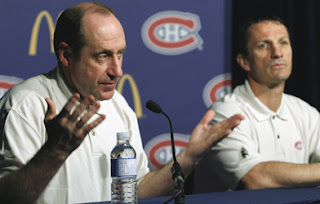
Let me start at the beginning here, by summarising why criticism of Bob Gainey (GM) is even pertinent at this time:
Eric Engels begins his own article by wondering how anyone could question Gainey. I think he is calling me (and others who question Gainey) a moron:
I suppose I merited that tag for being unclear. Of course, I don't question Bob Gainey's commitment, integrity or hockey knowledge. But, unfortunately for Bob, he is not the only good GM around. He is not even the only GM trying to set up a winning team. He is not the only GM to oversee a team with improving fortunes, either. I suppose the criticism (which I called disappointment) is that Bob, while doing an excellent job, is being outperformed. Or, at least has been outperformed over the last months. And, since there is only one trophy, being outperformed often means going home trophyless at the end of 8 long months of hockey.
Bob Gainey as GM has shown great talent for man management and hirings in the front office, a knack for the amateur draft and for signing players to good value contracts without hand-cuffing the franchise. His area of weakness, in my opinion, has been the addition of existing NHL talent – more specifically still: trades.
If you compare Bob to his peers, he appears to be more patient, more cerebral, and more cautious. All these characteristics serve him well for many of his duties, but as I questioned before, will Gainey be able move away from his patient, cautious approach and seize an opportunity when it comes?
Darren (from the comments of the last entry) noted that the Penguins GM, also in the midst of building a team gave up a lot for Marian Hossa, as he judged there was a chance to push for the Cup. At present, it seems like Shero's move is paying dividends, but we have yet to receive the final verdict. In any case, I wouldn't be writing this article about my GM if I were a Pittsburgh fan today. Shero wasn't the only GM to move. Brett Hull made a sly trade for Brad Richards, and his Stars, while reeling, are still alive too. Detroit didn't move too much at the deadline (Brad Stuart for free though), but amazed again last summer by adding the top free agent defenceman to their already talent-laden camp. While I don't like what Paul Holmgren did with the Flyers, no one can deny the jump they made in the standings. His notable addition of a veteran goalie has helped stem the tide of Nittymaki free-fall.
I could go beyond these four as well, but I won't. All this was to show that Bob Gainey, a talented guy, has talented peers too. And, from the looks of it, they are beating him handily at trades and attracting free agents, while he builds the patient way. I think if he wants to bring his team to the top table, he has to get a bit braver. If the biggest decision you make all season is whether to trade away impending free agents or not, perhaps he is getting left behind.
I say this like I say Plekanec needs to work on face-offs – a mere statement of opinion that one aspect of Bob's game could use a shine.
Evidence: a few recent decisions
Not trading Souray
Trading Souray would have been an obvious admission of defeat on the part of Bob Gainey. In his 5-year rebuilding plan, missing the playoffs in 2007 was a step backwards considering the team being employed in games and the free agent signings of the summer.
The incongruency with other moves (Rivet trade), however, suggests that Gainey may have attempted to trade Souray, but felt the value he would get in return was too low. Too low, even compared to 20 odd games worth of Sheldon, that is. It is also conceivable that Gainey legitimately wanted to sign Souray; and, as such, kept his man on board in order that they might work out a deal later. Either of these two give Gainey a legitimate excuse for the non-trade.
However, in the case of the Souray non-trade, I think we would be correct in speculating, however, that the playoffs (both for Gainey's record and Gillett's pocketbook) were a factor. If so, any reasonable critic could state that Gainey tampered with future success for a low-hanging fruit. A critic would not be wrong in pointing out that the move this year was inconsistent with the move last year – even at the risk of being called a moron by the eminent Mr. Engels.
My personal stance on Souray is ambivalence. I think calling him our best player last season is a stretch, considering how poor he was in his day-to-day position. It would have been nice to get something for him, but, I think the other GMs were wise to his deficiencies – so value would be lower. His points and goals during the stretch run provided hope and most of all entertainment.
At the end of the day, it's safe to say, I would have been upset with a draft pick for Souray just as I was for Huet.
Trading Huet
At the risk of angering the "get over it" gang, I'll voice my displeasure over this trade once again.
I should probably start by saying I would be pretty unhapppy at getting a second round pick for 80% of the current team. In principle, I think trading an NHL-calibre body for a 10% chance of getting an NHL body at some point in the future is lunacy. Apart from high first round picks, there are no guarantees in the draft. A second-round pick can turn into something special, but on average it won't.
I am also very much against making negative trades with players that aren't causing a problem of some kind on the team (let's say Dagenais as an example for that). There is absolutely nothing wrong, in my opinion, with losing a player for nothing if it means you get to keep that player for 20+ games. I have many times criticised Rejean Houle for this kind of negative management, and so to see Gainey resort to it was disappointing to say the least.
I also have to state, though, that I have absolutely nothing against a GM using his knowledge of the situation and intuition to determine that the time for his team is just not now. The Huet trade, if nothing else, announced to me that the GM of the team did not think he had the horses to run with Detroit, Dallas, Anaheim or San Jose. The evidence from the season would certainly prove him right.
All that said, I have yet to be convinced by anyone that trading Huet was necessary to allow Carey Price more starts – he could have been played more regardless of who was backing him up. Or to give Halak a real chance – but I think evidence for that theory has been blown out of the water. Or that Huet was a problem in the dressing room.
So what gives?
It all comes back to either money or the negative trade. Neither option offers anything positive for me.
You all know my opinion on Huet. But, on the trade itself, I was also disappointed. Brave would have been holding Huet when finding all you could get would be a second round pick. I thought the decision was neither brave nor creative. Creative would have been trading Halak in the hope that Washington would cough up more. What irks me is how unproductive and unnecessary the trade was. All told, it brought Gainey back down off his pedestal for me.
The Hossa non-trade
It's much more difficult to debate a non-trade than a trade since nothing is really known about it. What we do know about this particular non-trade was that Gainey was interested and he balked before the deadline at some point.
This non-trade is more interesting than the billions of other possibilities that could be dreamed up becuase it involved Marian Hossa – a scoring winger for Koivu. You see Hossa is a legitimate NHL star. He is a 40-goal threat, a puck carrier, a shooter and a nightmare for opposing teams to plan for. Most players could only dream of being as good as Hossa has been already.
The rumour is that player 1 in the trade for us was Christopher Higgins (at least for Waddell). For players like Hossa, a GM pays heavily (nothing is free), but in getting the best player in the trade often wins the trade by a landslide. In my opinion, it wouldn't matter who players 2, 3 and 4 were – especially if they were not in the NHL. So you have Higgins (and friends) for Hossa (20+ games). Under the circumstances, I think Gainey did the right thing here (especially having already traded goaltender insurance). A playoff rental would have gone against the grain of the team this year.
The order of proceedings
Finally, with regard to the trade deadline this season, you have the order of events prior to the trade deadline. Huet is traded then some time later Gainey pulls out of the Hossa trade.
This is noteworthy because it is in this order and not the opposite: Gainey pulls out of the Hossa trade then trades Huet.
In the latter, Gainey would have been trying to push his team over the top, been stifled, pulled out and then got what he could for a player who he deemed replaceable and unsignable.
In the former (and real) scenario, Gainey appeared to waver. It's only speculative of course, but by trading his number one goalie from a mere 2 weeks earlier (all-star and NHL three-star from January), Gainey paints the picture that he doesn't believe in the Habs playoff chances. Fair enough, he was probably right, but why then pursue a playoff addition like Hossa?
The move doesn't defy logic or anything, but it does defy (at least a little again) the idea that Gainey is infallible and without peer in the NHL.
The verdict
I hope Bob Gainey supporters understand that I still very much think he is a great GM. Possibly the best in the league, and certainly the best man for the Montreal Canadiens job. I merely question whether he will be able to deliver Detroit-style decade-long dominance if he doesn't adjust his game.
In my opinion, if he is to turn another rebuilding team into a dynastic rule, he must get a bit braver and more creative. I specifically point to trades as his area to focus his work on, as most other aspects of his GM play are top of the charts.
Nowadays, the price you should expect to pay to win the Cup is steep. This is simply because teams are playing for the single Cup – they will give up 5 years from now for this year. I think, as stated earlier, that he does need to be brave – probably this summer or next season – to add bodies the way his peers with playoff hockey to play and trophies in their cupboard do.
To win, even once, Gainey will have to play their game a little. If Gainey doesn't, and doesn't as a result ever move to the 6th year in his 5-year plan, we may just be lamenting the upshot team of the year (see Flyers this year) for many years to come.
The piece gave me direction (almost directly opposite) and a title. So here we go.

Let me start at the beginning here, by summarising why criticism of Bob Gainey (GM) is even pertinent at this time:
- The NHL season is not over, but the Canadiens are out
- The Canadiens lost to an opponent whom they beat 4 times in the regular season, in the majority of games the season before, were the worst team in the NHL the year before, in 5 games
- Bob Gainey both made moves and refrained from making moves over the season
Eric Engels begins his own article by wondering how anyone could question Gainey. I think he is calling me (and others who question Gainey) a moron:
What do you think of Bob Gainey now? It’s amazing how many people can doubt someone with as much integrity, and hockey-knowledge as Bob Gainey possesses. Moreover, it’s amazing how people doubt someone who’s proven that all his decisions are methodically considered, and unwavering under colossal pressure. He built a team that no one thought would contend for the playoffs, let alone the Stanley Cup, and yet there are still some morons out there who don’t understand the value of his decisions—decisions that gave our fair city the best hockey season we’ve witnessed in two decades.
I suppose I merited that tag for being unclear. Of course, I don't question Bob Gainey's commitment, integrity or hockey knowledge. But, unfortunately for Bob, he is not the only good GM around. He is not even the only GM trying to set up a winning team. He is not the only GM to oversee a team with improving fortunes, either. I suppose the criticism (which I called disappointment) is that Bob, while doing an excellent job, is being outperformed. Or, at least has been outperformed over the last months. And, since there is only one trophy, being outperformed often means going home trophyless at the end of 8 long months of hockey.
Bob Gainey as GM has shown great talent for man management and hirings in the front office, a knack for the amateur draft and for signing players to good value contracts without hand-cuffing the franchise. His area of weakness, in my opinion, has been the addition of existing NHL talent – more specifically still: trades.
If you compare Bob to his peers, he appears to be more patient, more cerebral, and more cautious. All these characteristics serve him well for many of his duties, but as I questioned before, will Gainey be able move away from his patient, cautious approach and seize an opportunity when it comes?
Darren (from the comments of the last entry) noted that the Penguins GM, also in the midst of building a team gave up a lot for Marian Hossa, as he judged there was a chance to push for the Cup. At present, it seems like Shero's move is paying dividends, but we have yet to receive the final verdict. In any case, I wouldn't be writing this article about my GM if I were a Pittsburgh fan today. Shero wasn't the only GM to move. Brett Hull made a sly trade for Brad Richards, and his Stars, while reeling, are still alive too. Detroit didn't move too much at the deadline (Brad Stuart for free though), but amazed again last summer by adding the top free agent defenceman to their already talent-laden camp. While I don't like what Paul Holmgren did with the Flyers, no one can deny the jump they made in the standings. His notable addition of a veteran goalie has helped stem the tide of Nittymaki free-fall.
I could go beyond these four as well, but I won't. All this was to show that Bob Gainey, a talented guy, has talented peers too. And, from the looks of it, they are beating him handily at trades and attracting free agents, while he builds the patient way. I think if he wants to bring his team to the top table, he has to get a bit braver. If the biggest decision you make all season is whether to trade away impending free agents or not, perhaps he is getting left behind.
I say this like I say Plekanec needs to work on face-offs – a mere statement of opinion that one aspect of Bob's game could use a shine.
Evidence: a few recent decisions
Not trading Souray
Trading Souray would have been an obvious admission of defeat on the part of Bob Gainey. In his 5-year rebuilding plan, missing the playoffs in 2007 was a step backwards considering the team being employed in games and the free agent signings of the summer.
The incongruency with other moves (Rivet trade), however, suggests that Gainey may have attempted to trade Souray, but felt the value he would get in return was too low. Too low, even compared to 20 odd games worth of Sheldon, that is. It is also conceivable that Gainey legitimately wanted to sign Souray; and, as such, kept his man on board in order that they might work out a deal later. Either of these two give Gainey a legitimate excuse for the non-trade.
However, in the case of the Souray non-trade, I think we would be correct in speculating, however, that the playoffs (both for Gainey's record and Gillett's pocketbook) were a factor. If so, any reasonable critic could state that Gainey tampered with future success for a low-hanging fruit. A critic would not be wrong in pointing out that the move this year was inconsistent with the move last year – even at the risk of being called a moron by the eminent Mr. Engels.
My personal stance on Souray is ambivalence. I think calling him our best player last season is a stretch, considering how poor he was in his day-to-day position. It would have been nice to get something for him, but, I think the other GMs were wise to his deficiencies – so value would be lower. His points and goals during the stretch run provided hope and most of all entertainment.
At the end of the day, it's safe to say, I would have been upset with a draft pick for Souray just as I was for Huet.
Trading Huet
At the risk of angering the "get over it" gang, I'll voice my displeasure over this trade once again.
I should probably start by saying I would be pretty unhapppy at getting a second round pick for 80% of the current team. In principle, I think trading an NHL-calibre body for a 10% chance of getting an NHL body at some point in the future is lunacy. Apart from high first round picks, there are no guarantees in the draft. A second-round pick can turn into something special, but on average it won't.
I am also very much against making negative trades with players that aren't causing a problem of some kind on the team (let's say Dagenais as an example for that). There is absolutely nothing wrong, in my opinion, with losing a player for nothing if it means you get to keep that player for 20+ games. I have many times criticised Rejean Houle for this kind of negative management, and so to see Gainey resort to it was disappointing to say the least.
I also have to state, though, that I have absolutely nothing against a GM using his knowledge of the situation and intuition to determine that the time for his team is just not now. The Huet trade, if nothing else, announced to me that the GM of the team did not think he had the horses to run with Detroit, Dallas, Anaheim or San Jose. The evidence from the season would certainly prove him right.
All that said, I have yet to be convinced by anyone that trading Huet was necessary to allow Carey Price more starts – he could have been played more regardless of who was backing him up. Or to give Halak a real chance – but I think evidence for that theory has been blown out of the water. Or that Huet was a problem in the dressing room.
So what gives?
It all comes back to either money or the negative trade. Neither option offers anything positive for me.
You all know my opinion on Huet. But, on the trade itself, I was also disappointed. Brave would have been holding Huet when finding all you could get would be a second round pick. I thought the decision was neither brave nor creative. Creative would have been trading Halak in the hope that Washington would cough up more. What irks me is how unproductive and unnecessary the trade was. All told, it brought Gainey back down off his pedestal for me.
The Hossa non-trade
It's much more difficult to debate a non-trade than a trade since nothing is really known about it. What we do know about this particular non-trade was that Gainey was interested and he balked before the deadline at some point.
This non-trade is more interesting than the billions of other possibilities that could be dreamed up becuase it involved Marian Hossa – a scoring winger for Koivu. You see Hossa is a legitimate NHL star. He is a 40-goal threat, a puck carrier, a shooter and a nightmare for opposing teams to plan for. Most players could only dream of being as good as Hossa has been already.
The rumour is that player 1 in the trade for us was Christopher Higgins (at least for Waddell). For players like Hossa, a GM pays heavily (nothing is free), but in getting the best player in the trade often wins the trade by a landslide. In my opinion, it wouldn't matter who players 2, 3 and 4 were – especially if they were not in the NHL. So you have Higgins (and friends) for Hossa (20+ games). Under the circumstances, I think Gainey did the right thing here (especially having already traded goaltender insurance). A playoff rental would have gone against the grain of the team this year.
The order of proceedings
Finally, with regard to the trade deadline this season, you have the order of events prior to the trade deadline. Huet is traded then some time later Gainey pulls out of the Hossa trade.
This is noteworthy because it is in this order and not the opposite: Gainey pulls out of the Hossa trade then trades Huet.
In the latter, Gainey would have been trying to push his team over the top, been stifled, pulled out and then got what he could for a player who he deemed replaceable and unsignable.
In the former (and real) scenario, Gainey appeared to waver. It's only speculative of course, but by trading his number one goalie from a mere 2 weeks earlier (all-star and NHL three-star from January), Gainey paints the picture that he doesn't believe in the Habs playoff chances. Fair enough, he was probably right, but why then pursue a playoff addition like Hossa?
The move doesn't defy logic or anything, but it does defy (at least a little again) the idea that Gainey is infallible and without peer in the NHL.
The verdict
I hope Bob Gainey supporters understand that I still very much think he is a great GM. Possibly the best in the league, and certainly the best man for the Montreal Canadiens job. I merely question whether he will be able to deliver Detroit-style decade-long dominance if he doesn't adjust his game.
In my opinion, if he is to turn another rebuilding team into a dynastic rule, he must get a bit braver and more creative. I specifically point to trades as his area to focus his work on, as most other aspects of his GM play are top of the charts.
Nowadays, the price you should expect to pay to win the Cup is steep. This is simply because teams are playing for the single Cup – they will give up 5 years from now for this year. I think, as stated earlier, that he does need to be brave – probably this summer or next season – to add bodies the way his peers with playoff hockey to play and trophies in their cupboard do.
To win, even once, Gainey will have to play their game a little. If Gainey doesn't, and doesn't as a result ever move to the 6th year in his 5-year plan, we may just be lamenting the upshot team of the year (see Flyers this year) for many years to come.
Wednesday, June 20, 2007
A Tale of Two Cities
Two cities, two teams, two GMs and two players. Bob Gainey showed this week while he is a notch above many of his peers, most notably Paul Holmgren of the Flyers.
I touch much upon the obscene numbers of Kimmo Timonen’s contract, except to say I’m glad Gainey didn’t lose his mind and offer the same to Timonen, or Sheldon Souray. What I wanted to address was two signings, albeit one in principle only, of two developing front-line forwards in the NHL: Chris Higgins and Scott Hartnell.
If you don’t think they’re similar, think again. This season saw Higgins get 22 goals and 16 assists in 61 games, Hartnell also registered 22 goals but chipped in an extra assist for good measure in 3 more games (for 39 points). Higgins is 24, Hartnell is 25. They were both first round picks.
From all reports, Hartnell is a hard-working winger who a team can rely on to score his share of goals. Given he has never cracked 30 goals, I think it’s safe to say he projects as a 30-goal man if you’re optimistic. He may even have a 40 goal season in him. Higgins is similar. He has 2 seasons under his belt, with 23 and 22 goals, respectively. 30 goals is probably about his potential. Either guy could prove me wrong and go to 40 goal scorer with the right center, I think.
My issue is not with either’s talent, or potential. My issue is with the difference in their pay for this and future seasons. Higgins was signed to a sensible 3.4 million over two years. In contrast, 22-goal man Hartnell was signed to a ridiculous contract averaging more than double that of his equivalent (Higgins) at 4.2 million a year – and for 6 years on top of it all.
If Hartnell breaks out and scores 30 goals a year for the first 4 years and then 40 in his last 2, then he earns his money. If he stays true to form (although that might be hard playing with lesser players in Philly) and scores 20-25 goals a year, the Flyers might be looking to buy this one out by 2010. Higgins, on the other hand, is a better scenario. If he scores his usual 20 goals, he earns his money. If he breaks out, he’ll be rewarded – LATER.
Watching the Canadiens, it is clear that we need more than Higgins. His 20 goals are nice, but scoring was lacking this year, even with him around. What Holmgren has done is commit 10 percent of his budget for the next 6 years (though the percentage may drop if the league does well) to a player in the same mould in Hartnell. He has also set a dangerous precedent in his team. How much will he have left for Gagne, Carter (if he ever comes good), Richards, etc.? How about a goalie? I wouldn’t want to be going through the next 6 seasons with Biron (just ask Buffalo).
Gainey paid Higgins for what he has done. He has engineered room for adding more elements to a cast that was already head and shoulders above the Flyers. He has enough room to sign Souray if he wants, but won’t do it at any price just because he can.
Whether trading for early negotiations was a good idea is another debate. At the ludicrous prices they set, I think the Flyers threw away a draft pick. I don’t think we’ll see Gainey doing the same trick anytime soon.
I touch much upon the obscene numbers of Kimmo Timonen’s contract, except to say I’m glad Gainey didn’t lose his mind and offer the same to Timonen, or Sheldon Souray. What I wanted to address was two signings, albeit one in principle only, of two developing front-line forwards in the NHL: Chris Higgins and Scott Hartnell.
If you don’t think they’re similar, think again. This season saw Higgins get 22 goals and 16 assists in 61 games, Hartnell also registered 22 goals but chipped in an extra assist for good measure in 3 more games (for 39 points). Higgins is 24, Hartnell is 25. They were both first round picks.
From all reports, Hartnell is a hard-working winger who a team can rely on to score his share of goals. Given he has never cracked 30 goals, I think it’s safe to say he projects as a 30-goal man if you’re optimistic. He may even have a 40 goal season in him. Higgins is similar. He has 2 seasons under his belt, with 23 and 22 goals, respectively. 30 goals is probably about his potential. Either guy could prove me wrong and go to 40 goal scorer with the right center, I think.
My issue is not with either’s talent, or potential. My issue is with the difference in their pay for this and future seasons. Higgins was signed to a sensible 3.4 million over two years. In contrast, 22-goal man Hartnell was signed to a ridiculous contract averaging more than double that of his equivalent (Higgins) at 4.2 million a year – and for 6 years on top of it all.
If Hartnell breaks out and scores 30 goals a year for the first 4 years and then 40 in his last 2, then he earns his money. If he stays true to form (although that might be hard playing with lesser players in Philly) and scores 20-25 goals a year, the Flyers might be looking to buy this one out by 2010. Higgins, on the other hand, is a better scenario. If he scores his usual 20 goals, he earns his money. If he breaks out, he’ll be rewarded – LATER.
Watching the Canadiens, it is clear that we need more than Higgins. His 20 goals are nice, but scoring was lacking this year, even with him around. What Holmgren has done is commit 10 percent of his budget for the next 6 years (though the percentage may drop if the league does well) to a player in the same mould in Hartnell. He has also set a dangerous precedent in his team. How much will he have left for Gagne, Carter (if he ever comes good), Richards, etc.? How about a goalie? I wouldn’t want to be going through the next 6 seasons with Biron (just ask Buffalo).
Gainey paid Higgins for what he has done. He has engineered room for adding more elements to a cast that was already head and shoulders above the Flyers. He has enough room to sign Souray if he wants, but won’t do it at any price just because he can.
Whether trading for early negotiations was a good idea is another debate. At the ludicrous prices they set, I think the Flyers threw away a draft pick. I don’t think we’ll see Gainey doing the same trick anytime soon.
Subscribe to:
Posts (Atom)